No Results Found
The page you requested could not be found. Try refining your search, or use the navigation above to locate the post.

The level of data-security that Microsoft provide is far higher than many companies can afford to provide by themselves, and it is all included in the price, taking that worry away from you.
Upgrades, maintenance, and system administration are all managed at Microsoft. This means you won’t need to spend time or energy managing a dedicated IT department or contractors when servers go down or software updates mandate a system tweak.
Because there is not a big hardware install, your capital expenditure is much lower. So you benefit from better cash flow and greater flexibility, which reduces your overall costs.
You can add or remove users as your business requires them. So short-term projects become cost-effective, because you only pay for additional license fees for the duration of the project. And as your business grows, so does Microsoft Dynamics 365. Because it can run 100,000 users concurrently, Dynamics 365 will never cap your growth.
Time is money, and with the on-premise set up being far more complex, you will get a much quicker return in your business if you opt for an online system. The online system can be installed in a day and your business can be running it at its max in a matter of weeks, meaning you’ll quickly see a meaningful return on your investment.
Wherever your company expands to you’ll find that there’ll always be a Microsoft partner proficient in Dynamics 365 nearby. This means that help or advice will never be far away. With Microsoft Dynamics 365 currently operating in 40 countries in 41 different languages, it’s truly a global product.
With the world becoming more mobile, it’s essential that everyone in your business can access information wherever they are. With Dynamics 365 you don’t even need a laptop as you can get full functionality via your tablet or even your cell phone (Android, iOS, or Windows).
You only pay for the users that are active on the system. In traditional deployments you purchase a number of licenses up front but with Dynamics 365, you can adjust what you pay according to the needs of your business. So the cost is mainly an operational cost, and only increases as your business does.
Microsoft promise a 99.9% uptime or they will give you your money back. With multiple global data centres, you don’t need to worry about glitches or bugs, or even cyber attacks, as Microsoft has this covered, leaving you to focus on your core business.
Because we care about your data, if you go with us, we’ll place your data in centres in Europe, where the strict European laws ensure that your data remains your own. In contrast, if you house your data yourself, you come under the data protection laws of the country that you reside in.
If you are looking for a fully connected system so you can focus on your business, view Microsoft Dynamics 365 here!
The page you requested could not be found. Try refining your search, or use the navigation above to locate the post.
Discover More Stories

Many state that the drawing really captures the essence of iterative and incremental development, lean startup, and MVP (minimum viable product). However, some misinterpret it, which is quite natural when you take a picture out of its original context. Some criticize it for oversimplifying things, which is true. The picture is a metaphor. That’s why we’ve made this video to put the picture in its true context. Enjoy.
Check out how our implementation process makes use of the minimal viable product.
The page you requested could not be found. Try refining your search, or use the navigation above to locate the post.
Discover More Stories

This is very manageable if you are a few consultants, but when you run complex projects, with many professionals required at different stages, most firms opt for a fully integrated Professional Services Automation System. A system like this can be the difference between firms growing and firms staying still. Small efficiency gains can result in big profits.
The global research organisation, Service Performance Insight (SPI), backs this up. Data from their 2016 report: PS Maturity Benchmark, taken from 257 organisations (minimum of 100 employees, average employee size 1,315) showed that companies with a Professional Service Automation Solution achieved 26% more profits than those that didn’t. When this was combined with a CRM (Customer Relationship Management) Solution profits increased by 44% compared to those professional service organisations with neither.
We at The CRM Team love to help companies increase their profits. We sell a Professional Service Automation Solution built by Microsoft, called Project Service. It’s a complete system for project sales, resourcing, delivery and billing. We love it. See if it could help you increase your profitability by watching the two-minute overview video above.
You also might like to read our article looking at its features.
The page you requested could not be found. Try refining your search, or use the navigation above to locate the post.

Waterfall relies heavily on initial requirements. However, if these requirements aren’t documented precisely, or there was a misunderstanding around the detail of what the customer wanted, it makes things very difficult. Not so with Agile – requirements are checked and confirmed throughout the project.
Once a step has been completed in Waterfall, it’s difficult to go back and make changes. In contrast, Agile builds a working version of the whole project (an MVP) so the customer can shape how it’s built. Seeing a working version early on in the project allows the customer to say ‘I like this, but I don’t like that’, and so shape the product according to their requirements. This is harder to do with Waterfall because the customer has to outline all their preferences upfront, without seeing a working version.
With Waterfall, the product is mainly tested at the end of the project. If the customer’s needs weren’t captured well initially or they have changed since the start of the project, testing may come too late in the cycle to make big adjustments. The customer then has to find extra budget to get the product they now need. With Agile, testing happens regularly through the whole process, so the customer periodically checks that the product is what they envisioned. This also makes it more likely that the project will finish on time, and on budget.
Waterfall isn’t geared to take into account a customer’s evolving needs. If business processes change during the project Waterfall isn’t set up to adapt to this. Often a client feels locked into a project that no longer meets the current business need. In contrast, Agile not only has the ability to adapt to changing needs, but it expects them and plans for them.
Agile sees the customer as part of the implementation team and includes them at each part of the process. In contrast, Waterfall tends to spend a lot of time with the customer at the start, trying to document all the perceived requirements. But once this has happened, the implementation team usually take over.
Want to find out more? See our approach to CRM implementation.
The page you requested could not be found. Try refining your search, or use the navigation above to locate the post.
Discover More Stories

When people get more freaked out about being separated from their phone than their cash you know a paradigm shift has occurred.

Here’s the rub: like Yellow Cabs, your company may be late in embracing digital transformation – but your customer’s aren’t. They’ve already digital and they’re looking for businesses who understand how they operate and who talk their language.
Here’s another example: My business partner recently took his wife away for a long weekend. He went all out. Do you know where he stayed? In an AirBnB. He booked his beautiful, luxurious getaway through an app on his phone. The Marriott or Hilton didn’t get a look in.

Microsoft’s new CEO, Satya Nadella, who’s carried out his own digital transformation, says this:
Engaging your customers… empowering your employees… optimizing your operations… reinventing your business models – this is nothing new. Every great business leader in history has been on top of these. The difference nowadays is that the pace of technological advance is so great that if you don’t keep up you can quickly become a dinosaur – and you won’t even know it until it’s too late. Save & Exit
“Organizations must embrace a digital culture now or be embarrassed by it later.”
How is your industry doing in the realm of digital transformation? Could your industry be the next one to be disrupted by a tech-savvy start-up?
Last year, Accenture Interactive commissioned a Forrester survey of 396 organisations (minimum 1000 employees or more). They found:
Taken from ‘Digital Transformation in the Age of the Customer’
So. You’re aware of the threat/opportunity. What should you do?
The first thing you need to do is take Braden Kelly’s advice:
“You must look at your business and your industry in the same way that a digital native startup will if they seek to attack you and steal your market.”
Put yourself in the shoes of your customer. What aspect of their interaction with you feels old fashioned or clumsy? What are better ways of doing this? If you were a start-up and looking at things from a fresh perspective, what would you do to disrupt the industry?
For the Huffington Post, an online newspaper founded in 2005, that meant using the web, rather than print, to take on the big newspapers of the day. It sounds straight-forward, but HuffPost has also embraced marketing automation technology and has a highly-developed social media strategy.
But in doing so, it’s been successful. In 2011 it was acquired by AOL for $315m. In March 2016, the British national newspaper The Independent followed it’s lead and also became an online-only newspaper – halting its print run, that at its peak, had a daily production of 97,000 newspapers. The newspaper industry is in a fast-paced digital transformation.
A look at what’s possible
You might be saying ‘this is great, but I don’t actually know what is possible in my industry?’ This is understandable, but in the digital age, it’s become the job of every business leader to be familiar with the latest technology trends. It might give you just the advantage you need over your competitors.
Have a look at what is trending currently:
Beginning the Digital Transformation Journey
Of course, you don’t even need to use these technologies for your company to begin the journey of digital transformation. You need to see a new way of operating and adopt the technology that helps you do that. Technology is simply the tool that you use.
Let’s talk
Whatever your industry, here at The CRM Team we are helping many companies take their first step (or next step) along the digital transformation journey. Whether it’s as simple taking your sales team off Excel, or more complex projects, such bringing consistency with the way you engage with your customer over the four customer touch points, we can help. And of course, we’re also geared up to help you use some of the trending tech such as IoT, Machine Learning, Integrated business apps, bots etc.
What opportunity will digital transformation create for your business?
What risks does it pose?
We’d love to assist you to take your next step. And in a digital world, it doesn’t matter where you are based. Why not arrange a conversation about it today?
The page you requested could not be found. Try refining your search, or use the navigation above to locate the post.
Discover More Stories

Since then we’ve learnt 3 fascinating facts about the deal:
And the deal is still making waves!
Salesforce’s CEO, Marc Benioff, is obviously rattled. After a period of collaboration and partnership, he has now declared the rivalry with Microsoft is back on. His words are defiant, but it doesn’t look great for the CRM-focused company. Microsoft’s new combined cloud CRM/ERP offering, Dynamics 365, with LinkedIn’s mighty Sales Navigator is going to be a potent combination and a big worry for them. This was a big win for Microsoft and LinkedIn. Salesforce.com lost out – big time.
But it would be unfair to make this a deal about Dynamics CRM vs Salesforce.com. It was much bigger than that. And both Microsoft and LinkedIn know this. You can’t box the 10,000 strong, 433 million member, professional network megalith as a simple CRM add-on. Jeff Weiner, who remains as LinkedIn CEO, said that Microsoft gives LinkedIn “advantages most companies can only dream of leveraging”. That’s got to hurt, Marc.
Microsoft CEO, Satya Nadella, was also very excited about the deal:
‘[it] brings together the world’s leading professional cloud with the world’s leading professional network’
We agree. With a combined reach of 1.5 billion+ people (Microsoft’s customer base and LinkedIn’s membership), the possibilities are staggering.
“Think about it: How people find jobs, build skills, sell, market and get work done and ultimately find success requires a connected professional world.”
Microsoft already helps over 1.2 billion people become more productive through the Microsoft Office suite. Imagine integrating LinkedIn with this. LinkedIn’s reach increases dramatically, and Office’s usefulness gets better and better. Nadella has stated that Microsoft wants to integrate the LinkedIn data with their artificial intelligent assistant Cortana. As Nadella said, “Imagine walking into a meeting and Cortana tells you about people you are meeting and what you need to know about them”.
‘not pressured to compromise on long-term investment… or hamstrung in the way we can reward and acquire new talent due to stock price concerns’.
Weiner predicts that through combining with Microsoft they’ll now be able to innovate and disrupt in some of the following areas:
“the corporate directory, company news dissemination, collaboration, productivity tools, distribution of business intelligence and employee voice…”
Prepare for more creativity and innovation from LinkedIn.
And the timing is great.
Digital Transformation is going to be a huge thing for companies in 2017 and much of this will result in big growth for cloud computing (read: Saas, PaaS and Iaas).
The SaaS (Software as a Service) market is growing rapidly (33% growth last quarter) and there is plenty of scope for Microsoft | LinkedIn to dominate here.
When it comes to IaaS and PaaS (Infrastructure/Platform as a service), Microsoft are already positioned well here, second behind Amazon, but ahead of Google and IBM. If, as predicted, LinkedIn moves its hosting to Microsoft’s Cloud (Azure) then that will bolster Azure even further.
But the Microsoft | LinkedIn deal is not just a strategic move to stop Amazon getting LinkedIn’s business. What Microsoft and LinkedIn realise is that currently their offerings and customer base are quite different. Place them all on one platform and the combined graph is eye-watering for developers:
Who can compete with that?
This deal is a great move for both Microsoft and LinkedIn and it’s going to shake up many industries. There should be lots of companies having sleepless nights – for a good while to come.
The page you requested could not be found. Try refining your search, or use the navigation above to locate the post.
Discover More Stories

That’s how much companies around the world threw away on IT projects. We’re talking ZERO return on their hefty investments.
But it doesn’t have to be this way.
There’s a secret that all successful companies know: Early User Testing.
The old model of ‘Collect – Build – Test’ is dead. No matter how good you are at business strategy, if only let your users in at the end you’re carrying huge risk.
Michael McWatters, UX architect at TED, puts it this way:
“Even the best teams can’t predict every possible pitfall.”
Companies like Uber and AirBnB get this. They ship early and often. By doing this they get crucial feedback from their end-users. The product is shaped so that it genuinely meets a need, mitigating their risk.
It costs 30-100 times more to fix a problem after a project has finished than during it. So this approach makes financial sense as well.
Dr. Susan Weinschenk, Chief of UX Strategy at Human Factors International, said business applications need to do three things well:
The only way of being sure about the first two is to get real user feedback.
But doesn’t Quality Assurance testing do this?
“You might think you’ve addressed every flaw in your design, but until you get user feedback, you won’t know how people really use and perceive what you’ve created.”
Without involving end-users, a business app can pass QA testing but fail on the following:
Fixing these problems after deployment has happened is a frustrating and costly exercise. The cost-effective solution is to get the end users in early.
But how do you do that when the solution isn’t fully deployed?
The way to do get end users in early is to use an iterative deployment process. You produce a working version early (called a minimal viable product) and then run cycles of test and improve, test and improve etc. Depending on the project, it should take days to just a few weeks to get an MVP going. As soon as this is ready you get the end users in to test it and using their feedback you run the next iteration cycle and present again.
Over a three-month deployment, if the iteration cycle is three weeks, the end users would have experienced a version of the application at least four times. With their input, it would have gotten better and better each time.
This process is becoming the standard way to do deployments. Because it gives the customer such flexibility it is aptly named Agile.
We love it and can’t imagine doing deployments any other way.
Our customers get what they want and we get the satisfaction of adding genuine business value to the companies we serve.
Don’t waste money deploying an IT solution that doesn’t suit your users – get them in early. Your users are key.
The page you requested could not be found. Try refining your search, or use the navigation above to locate the post.
Discover More Stories

Staying ahead of the competition is a must. Here’s six things you need to be doing as a sales manager in 2018:
Gut-feel and experience are essential guiders of decisions in sales teams, but these shouldn’t be used alone. Accessing relevant data to get feedback and forecast is now standard in today’s technology age. Modern sales apps allow pro-active tracking of customers and competitors. This reduces guesswork and enables metrics to be developed that are useful predictors of buying behaviour. Accessing real-time feedback also revolutionises sales meetings. Instead of spending time getting status updates, more time can be spent on coaching and training. Easy-to-see overviews tailored to your requirements make forecasting a pleasure. With a full sales solution, sales processes can also be standardised and streamlined. This leads to greater efficiencies and quicker onboarding of new sales reps.
Syntel Case Study
Syntel is a US $825m IT and outsourcing company. Recently, they were growing rapidly and needed a system to revamp their sales processes. They needed something that could manage leads and opportunities right through to closure. The ability to integrate marketing campaigns was important to drive impact and growth. By deploying a Microsoft Sales and Marketing solution, they were able to see their sales pipeline at multiple levels in real-time. Global account teams were able to see the progress of their colleagues in different territories. This spurred teams on to better performance. Revenue forecasting became much more reliable and sales processes were tracked and improved upon. This allowed growth to continue. Management of sales teams became so much easier. You can read the full case study here.
When a sales rep moves on, valuable customer information may go with them. This is always a risk if reps keep their own prospect and customer data in spreadsheets. The solution is to bring it all into the cloud in one system. That way everyone on the team can see the data and add to it, giving a richer understanding of the customer. Your customer and prospect data is a key asset for your sales team. Centralising this allows the information to grow and mature.
Trek Case Study
Trek sells bikes through a network of independently owned retailers. They rely on a close, supportive relationship between the local sales reps and the store owner. In the past, when a rep left or retired it would take years to rebuild the rapport and customer knowledge. By installing a Microsoft Sales solution, Trek were able to see account histories, financial data and inventory all in one place. New reps had all the info they needed to connect meaningfully with store owners. Event reports and weekly updates were sent out using the sales solution. This ensured sales reps had detailed records on customers, making the customers feel known and cared for. You can read the full case study here
Reps spend 75% of their time on non-selling activities. But with modern sales apps, this can be dramatically reduced. Empower your sales reps to have all the customer info they need on their phones. Allow them to update deal info as soon as the meeting is over and so give you accurate forecasting information. There are a number of comprehensive systems on the market. At The CRM Team, we use the Microsoft Dynamics 365 for Sales (compatible with iOS, Android and Windows). It has seamless integration with Office 365.You can track all your customers and prospects without ever leaving Outlook.
CSX Transportation Case Study
CSX Transportation has 32,000 employees. Previously, customer information was spread over multiple systems. There was no way of seeing customer touch points across different business groups. Frustratingly, sales information wasn’t held centrally. By bringing all this information into one system, sales teams were able to save on their admin time. Consequently, they spend more time building customer relationships. It was only a matter of time before revenue increased. Read the full case study here
Nowadays, the best sales teams collaborate regularly on accounts. Learnings are shared across teams, and cross-selling opportunities are identified more easily. This is the case whether you run an inbound sales team or have reps on the road. With greater collaboration, teams can respond quicker to new sales opportunities.
Nat West Bank Case Study

Recently, UK Bank Nat West installed a Microsoft CRM solution, going live to 3000 users. Now, when a customer contacts the bank, sales staff have all the relevant information at their fingertips. It doesn’t matter which team the customer made their initial contact with. This smart pooling of customer data has led to increased cross-selling. The increased revenue from this alone will provide a return on investment by 2018. Read the full case study here.
In a world of smart phones, it’s only natural that sales and customer data should be accessible via mobile devices. This sort of access not only increases productivity but also keeps sales teams connected and aware of what each other is doing. Mobile sales solutions allow for flexibility and responsiveness to customer needs. A good system will be able to work whether there is web access or not. It should also provide a cloud backup so that data is never at risk.
Grant Thornton Case Study
Grant Thornton LLP is one of the world’s largest professional services providers. Recently, they installed a new CRM solution with mobile sales capacity. Rick Stow, their Head of Client Relationship Management, said: “One of the most appealing aspects… is the ability to deliver the same experience across multiple platforms. Whether you’re opening a form from within Outlook, from a browser, or on a mobile device, you have full functionality.” Stow says this has resulted in their workforce being more connected and more productive. Ultimately, enabling them to service their clients better. Since upgrading to a CRM system with a mobile sales capability Grant Thornton LLP has experienced:
– a 450% jump in the number of sales opportunities,
– a 36% increase in average win value, and –
– a 700% rise in the number of contacts in the system.
Read the full case study here.
Not knowing when prospects interact with you is a hinderance to your sales process. By adopting a combined marketing and sales solution you can get quick insight when prospects browse your website, read an article or download a white paper. It also helps marketing and sales team align better, ensuring that marketing hands over only quality leads.
Crowe Horwath Case Study
Crowe Horwath LLP is a performance consulting firm. They decided to bring all sales records and customer information under one sales solution. Dave Keever, Principal at Crowe explains the impact:
“We now have full visibility of our marketing efforts around a contact or account. We can see, for example, if a customer or prospect opts in on an email or has downloaded any of our white papers, and we can then discuss that with them in a meeting. Before, it could take a day or two to find out about an account and the surrounding marketing activities. Now, it takes seconds.” Keever says that the adoption has been very cost effective: “Both the greater visibility into our sales pipeline and the increase in the number of users are contributing to our return on investment. We expect the payback period to be between nine and 15 months.”
Read the full case study here.
The page you requested could not be found. Try refining your search, or use the navigation above to locate the post.
Discover More Stories

Now those sleepless nights have arrived!
On Monday, Microsoft and LinkedIn threw out their first challenge to Salesforce.com. In an article released by Reuters, Microsoft CEO, Satya Nadella shared the companies plan to integrate LinkedIn data with their Dynamics 365 offering.
According to Microsoft, the upgrade will help salespeople become more efficient. With new insights from LinkedIn’s 500 million professionals, this solution will help salespeople improve their pipeline by,
The new solution will comb through a salesperson’s emails, CRM, and LinkedIn to gain insight into their relationship with a potential customer. And ultimately give recommendations on the next best action to take.
“We’re introducing a single offer that brings together LinkedIn Sales Navigator and Dynamics 365 for Sales… at about half the cost of competitive solutions.” Said Microsoft on Monday.
“I want to be able to democratise A.I. so that any customer using these products is able to take their own data and load it into A.I.”
“This is really all about expanding the opportunity we have, going beyond productivity and collaboration tools, to having a professional network.”
We all know LinkedIn is the business social hub and is a fantastic source of data for salespeople. So, we’re excited to see the first updates to Dynamics 365 that will include LinkedIn.
Read the full article here: Microsoft’s Nadella banks on LinkedIn data to challenge Salesforce
The page you requested could not be found. Try refining your search, or use the navigation above to locate the post.
Discover More Stories

You’re about to report your numbers to the board. And you know you’ve missed your sales target.
You’ve either over committed and under delivered. Or under committed and over delivered. Either way, the consequences are dire – you’ll lose your customers.
Imagine this…
You weren’t able to close that final deal in time. Now you’ve missed your target by R1 000 000. The company was therefore, unable to procure enough stock to meet orders. One of your customers was left waiting longer for delivery than agreed. As a result, that customer cancelled further deals with you.
Or this…
You brought a deal forward. And the business wasn’t able to make provision for the stock required to actually deliver on the deal. This ended up with a delay in delivery to the customer. As a result, the customer was unhappy and swore to never use your company again.
Now you’re thinking, “How did this happen?”
A survey done by Talk Business showed that 70% of Salespeople regularly miss targets.
That’s a scary number, and one that’s probably making you question the effectiveness of your Sales team. But have you really dug into the root of the problem? Let’s look at where things might be going wrong.
The first hurdle to making your target is getting leads. Right? Wrong! The first hurdle to making your target is getting the RIGHT leads. And those leads come from Marketing.
Does this sound familiar?
Sales:
‘I need local leads! But all these leads are from an internet cafe in Bangalore!’
Marketing:
‘But you never said that when you briefed us! You just said you needed 150 leads by Friday. And we delivered!’
Salespeople are optimistic by nature. Some will walk in after the first meeting with a new client bragging, “that deal is going to close. It’s going to close tomorrow. And it’s going to be huge!” But it never happens like that. Companies don’t spend millions of Rands at the drop of a hat. There are steps that must take place before a customer will spend money with you.
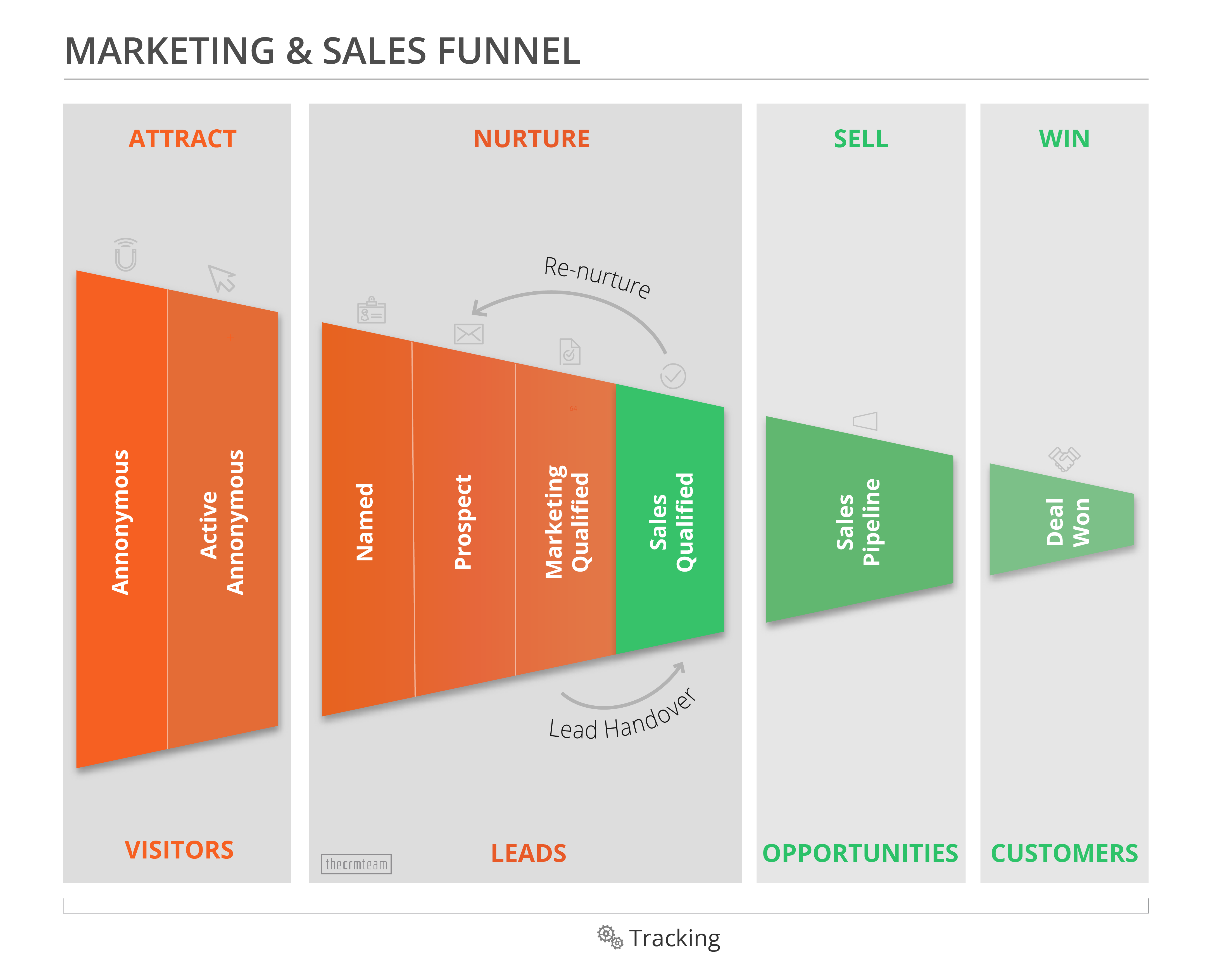
That’s why your sales process is vital to the success of your Sales team. If each sales opportunity is handled differently, the results are hit or miss. And if you’re not making your targets, we’re guessing it’s a miss.
Salespeople are naturally intuitive. That’s what makes them good at their jobs. But it also means they can get away with a lot. It’s not hard for them to buck the system. To move deals in the pipeline, or shift them out. They’ll do whatever it takes to get out of a difficult conversation.
Actionable insights are crucial to meeting your targets. For example, knowing how fast deals move through the sales pipeline allows you to accurately forecast when it’ll close.
According to CSO Insights, the average sales forecast accuracy is below 50%.
Getting your Sales and Marketing teams working as one unit will ensure you’re handed the RIGHT leads. Giving your Salespeople a better chance at conversion. In our company, we align our Marketing and Sales teams by adopting a specific methodology. We put this into a free eBook that you can download here.
You want to ensure all your Salespeople are speaking the same language. So, you need a structured sales process.
Start by creating a step-by-step structure, with defined gates and stages. This will ensure your Salespeople know exactly where their deals are in the sales process. And because it’s so clear, it’s obvious what the next action is and how the deal will progress to the next stage.
Plus, now that everyone is speaking the same language (and entering data the same way) your reporting becomes accurate!
An important thing to remember is that the sales process isn’t static.
Keep evaluating and refining the process. This will guarantee you always have the most effective way to win new customers.
Many sales leaders fail because they don’t question. Asking simple questions like, “are we missing a stage?” or “do we have too many stages?” or “what else do we need at a certain stage?” gives you the insight needed to keep your sales process working for you.
These kinds of questions also allow you to refine your process. You never want to rush your sales process, but you want to condense it where possible.
For example, a CRM system allows you to send a quote right away. Reducing the time it takes to get the right information to your customer. Allowing them to decide sooner. Condensing the process, helping you reach your targets.
It’s your job as the sales leader to get buy-in and prove to your team that the sales process is going to serve them as well as the business.
Ensure your team are clear on each stage of the process and why it’s there. Show them (as simply as possible) how each stage affects their deal.
Try reinforcing the importance of the process. Tie rewards and recognition to implementing the sales process (rather than strictly to wins).
We also recommend employing a method of coaching. It’s easy for Salespeople to fall back into old habits. So, effective sales coaching is an important element of sales success. Evaluate each Salesperson’s needs and set coaching sessions accordingly. And remember to ensure they schedule customer meetings around their coaching sessions.
“You have to ensure that the learning is reinforced so Salespeople don’t forget what they learned.” – Mike Schultz (President of RAIN Group)
“You have to ensure that the learning is reinforced so Salespeople don’t forget what they learned.” – Mike Schultz (President of RAIN Group)
Technology is all about simplifying our lives. Take CRM systems for example. They’re designed to help you meet your targets. How? By giving you an easy way to track your pipeline, apply your process, and sell more! Yet many companies are still relying on spreadsheets to store important sales data.
Did you know? 82% of top-performing Salespeople said, sales software is “critical” to their ability to close deals.
Machine learning is the evolution of customer experience. Machines are now learning how people interact and communicate. Opening the door for Sales to take advantage of “engagement recommendations”. Enabling them to provide the most relevant information to the customer. Which will help them close deals.
How it works:
Machine learning uses data based on a customer’s preferences and social activity. With this data, Salespeople can get real insights into the best time and channel to call or visit a customer. And get suggestions on the most relevant content or offer to send to a customer.
The best part is, this isn’t some futuristic idea. Recently, Microsoft announced their plan to integrate LinkedIn data into Dynamics 365. According to Microsoft, the upgrade will help Salespeople become more efficient. Using data and insights from LinkedIn’s 500 million professionals.
Remember it’s all about the customer! So, the more you know about what your customer wants and needs, the easier it’ll be to sell to them.
Remember, sale targets influence forecasts. And each team in the business works off your forecast. That means that problems run downhill, and might affect customer experience.
And as the sales leader, YOU’RE the one who loses credibility!
So, look at the reasons why you’re missing your target. Where did things go wrong? The moment your sales process started? Is your process structured enough? Did you have the insights you needed?
Once you’ve unpacked the problem, use the steps discussed in this article to fix them:
The page you requested could not be found. Try refining your search, or use the navigation above to locate the post.
Discover More Stories