No Results Found
The page you requested could not be found. Try refining your search, or use the navigation above to locate the post.
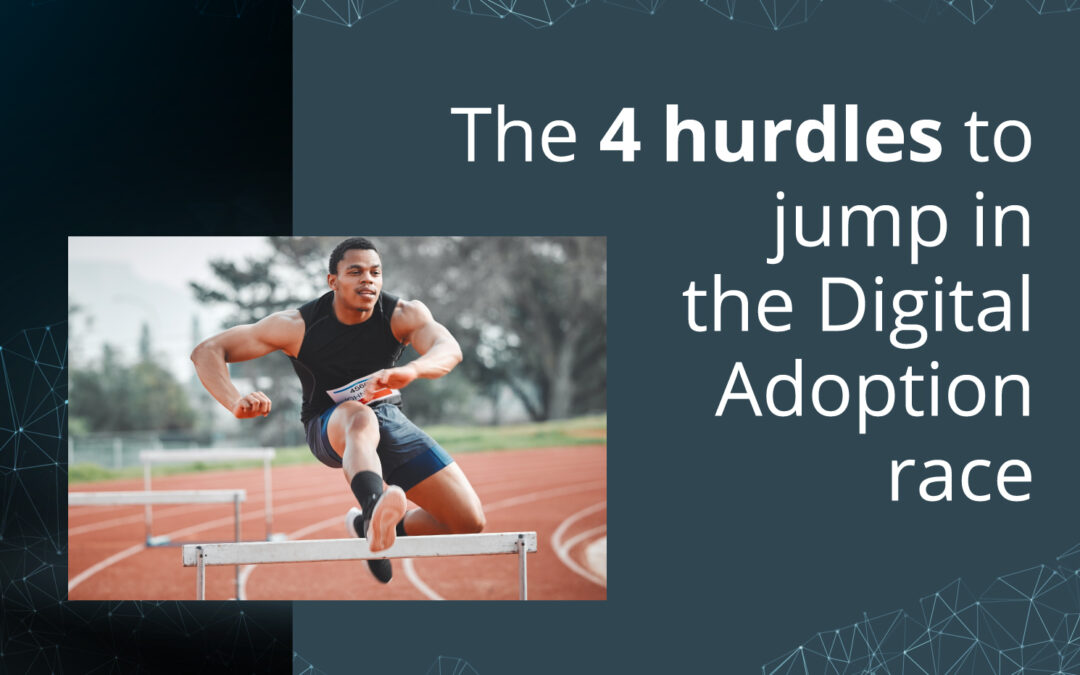
With the onset of the pandemic in 2020, it was as if the entire world went digital. Companies enabled remote work, retailers encouraged online shopping, and staying in touch with loved ones became entirely virtual. Although so many aspects of our personal lives have been transformed through digital services, there is still a great deal of work to be done when it comes to digital adoption within the workplace.
Let’s take a look at some of the challenges companies face when it comes to digital adoption and how we can help you overcome them.
The ultimate goal for most organisations is to create happy clients who return. A digital-first strategy should not only enhance customer service but also create a meaningful and positive experience for employees. However, even investing in the most advanced software money can buy will yield a low ROI if no one in the organisation wants to use it.
This is where we can help you through change management. We focus on changing the mentality and approach throughout all the levels in your organisation in order for the implementation of new technology processes to be met with enthusiasm and optimism instead of resistance and fear of change.
A 2021 Digital Business study mentions that businesses who adopt a digital-first strategy can expect an average revenue increase of 34%.
According to a study published, employees spend an average of 22 minutes every day figuring out how new applications work.
To decrease and potentially eliminate this time expenditure, companies need to prioritise the onboarding process of new employees, upskilling existing employees while tackling challenges linked to data processing, customer intimacy, speed and customer journey optimisation.
In order to drive digital adoption and boost a digital skillset, organisations have to work on making the interaction between humans and machines as natural as possible.
In areas like automation, machine learning, and artificial intelligence; innovative applications that provide and organise information into usable data in real time is required. So are the skills to utilise the software.
In life there is always something new to learn. So, implementing the same lifelong learning culture and mentality within your organisation will help keep your company on top.
Investing in your employees and regularly upskilling them with crucial digital know-how is vital to guarantee scalability and sustainability. This will dramatically increase the ROI derived from the implementation of new software and creates more room for innovation as employees gain an understanding of digital workflows and processes.
A digital-first strategy and its supportive solutions go hand-in-hand. One cannot thrive without the other.
Many businesses realise the need to transform and that being digitally enabled will help them gain a competitive advantage. However, there are many businesses that feel they’re missing the mark when it comes to solutions that support their strategy.
As we know with digital infrastructures and software, updates and changes in technology occur so frequently that traditional training simply can’t keep up. Combining that with the fact that people forget 90% of their training within a month, it’s easy to see just how important it is to have solutions that support your digital strategy.
To compensate for the training and retraining programmes, you need to have an agile solution that provides performance support, such as a User Adoption Strategy which happens to be our forte!
If you’re ready to become a confident, digital-adept organisation, click below.
The page you requested could not be found. Try refining your search, or use the navigation above to locate the post.

The disruption and advancement we’re currently experiencing is largely because of the technology landscape that has changed, there’s no going back. On-premise business solutions and costly infrastructure is something of the past.
All businesses were built on state-of-the-art on-premise technology, but this is now ineffective and insecure. Agility, scalability, accessibility and mobility have never been more important, especially as new trends continue to challenge businesses, solutions, and processes alike.
Moving to the cloud has to be a business priority for any modern organisation. This isn’t something that happens overnight, one needs to build a plan, strategise and take manageable steps.
Firstly, when it comes to business solutions, start by understanding the Microsoft Dynamics 365 Power of the Cloud and the benefits it offers. This will certainly challenge the traditional way of thinking and misconceptions about cloud. One needs to understand that on-premise CRM or ERP solutions cannot deliver on the needs and expectations of future organisations.
What used to be good enough is no longer good enough. It is common to hear business leaders, especially in finance and operations, claim their existing systems work just fine. But unfortunately, complacency in business is often the downfall of innovation and growth.
The fact is, although on-premises solutions are good enough for now and get the job done, they are fast becoming obsolete and more importantly, the competition is using the cloud to accelerate growth.
It’s time to take advantage of Dynamics 365 data integrations, out-of-the-box functionality, plus advanced machine learning and predictive analytic capabilities. This will certainly optimise legacy processes in real-time, outpace, out-manoeuvre and out-earn any on-premises competitor.
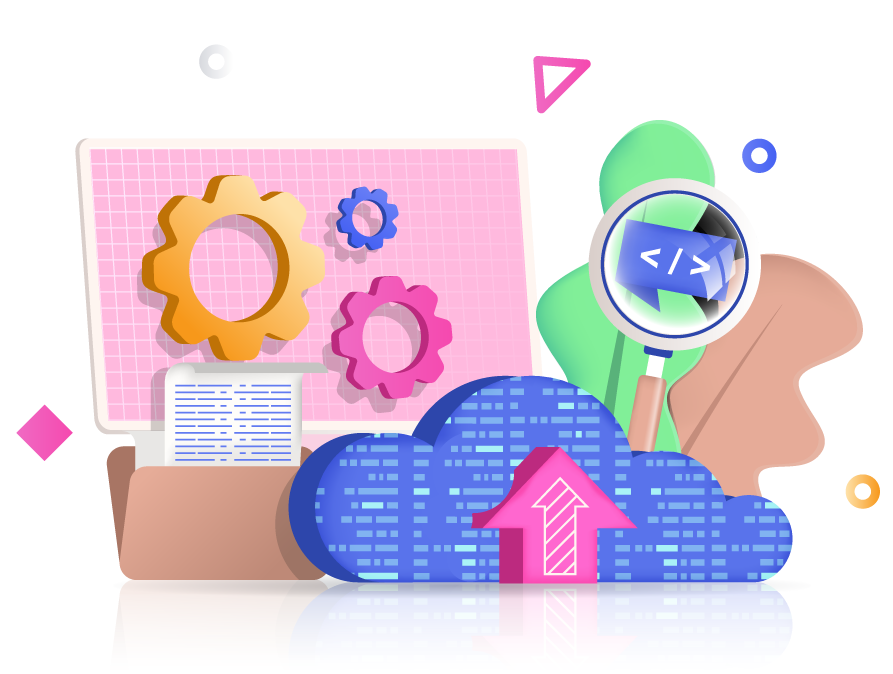
Most old school business owners have a misconception that their business needs are unique and this is a barrier to migration. It is common among on-premise businesses that have developed customised solutions over many years. Their business needs are not as unique as they think.
Migration to the cloud can help businesses eliminate cumbersome customisation and at the same time, massive expenses, infrastructure and processes. Often what they consider to be unique, is less about the specialised requirements of a given IT environment and more about what is perceived to be proprietary. They often have a limited understanding of what is possible in the cloud.
Moving on-premises Dynamics CRM solutions to Dynamics 365 Cloud can help businesses create efficiencies, control costs and improve productivity with a migration assessment.
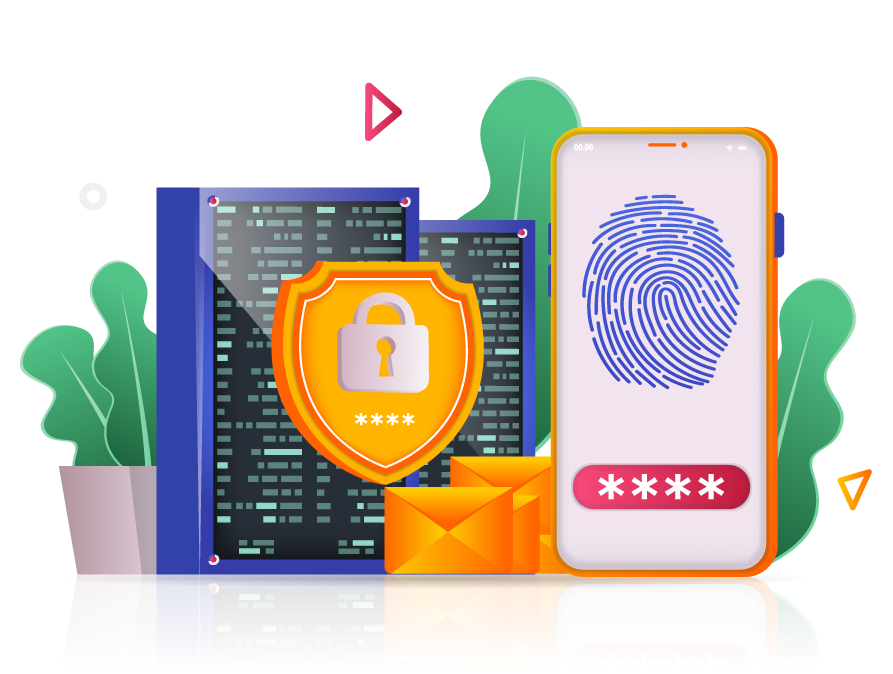
Business leaders can have peace of mind knowing their sensitive business data is stored in highly secure, state-of-the-art data centres owned and managed by Microsoft. Their data will be there when they need it, thanks to a 99.9 percent uptime service-level agreement (SLA).
Typically, CRM and ERP data has been maintained separately. Dynamics 365 allows one to connect this data for a 360-degree view of the business and access it from familiar solutions like Microsoft 365 and Microsoft Power BI.
Support business growth without costly changes to your IT infrastructure, including the ability to quickly activate and deploy new users.
Improve IT productivity by reducing the complexity associated with managing hardware and software and providing support. Eliminate the hassle of software maintenance tasks – such as backups, upgrades, and patches -and free up IT staff to focus on strategic planning and other high-priority work items.
Enhance the Dynamics 365 experience with prebuilt business applications, developed by Microsoft and select partners and available through the Microsoft AppSource marketplace. If a business has a unique need, build apps using Microsoft Power Platform and then customise and extend them.
Enhance teamwork and boost productivity by accessing information from anywhere, at any time, from any device. Enable remote employees to share information in real time, allowing for easier and more efficient collaboration.
Dynamics 365 provides the tools and information businesses need to compete, succeed and excel by providing access to innovations like AI and predictive analytics.
Microsoft Dynamics 365 is an end-to-end software-as-a-service business platform that comprises of interconnected workloads and services designed to both transform and enable an organisation’s core customers, employees and business activities.
It combines all the workloads that a business needs to run including finance, sales, supply chain, retail and customer service. It also includes AI and machine learning to enhance core offerings and provide industry-leading solutions to common problems like AI-enhanced cash flow forecasting, and the optimisation and automation of order fulfilment.
Finally, Dynamics 365 is built on Microsoft Azure, which offers a trusted platform and a broad ecosystem of services, and it is integrated with Microsoft 365’s productivity apps such as Outlook, Office and Microsoft Teams.

Emil Hickley- Head of Engineering
Emil’s aim is to create beautiful, easy-to-use products that people enjoy using. He specialises in SaaS. He is passionate about talking business, strategy, and devising pricing strategies.
The page you requested could not be found. Try refining your search, or use the navigation above to locate the post.

Marketing and sales strategies require some finesse in order to convert consumers into paying customers. Long gone are the days when you could cast your net wide in the hopes of catching one or two fish. Consumers are becoming more particular about how they interact with businesses and brands and how they prefer to be marketed to.
People prefer, and often expect, highly individualised marketing efforts that speak directly to them. Although it is possible to provide these kinds of experiences while manually performing your marketing and sales activities, it is no longer practical. You or your marketing team could end up spending a significant amount of time and resources on designing and implementing tailored marketing messages in the hopes of converting one or two customers. Marketing automation systems can help you market more effectively and efficiently.
Sales and marketing teams are more efficient.
Using a marketing automation system frees up your marketing team since they will no longer need to manually manage many marketing-related tasks. That means they will have more time to strategise and focus on generating even better marketing content, campaigns, and projects. The same goes for your sales team.
A marketing automation system usually centralises most, if not all, marketing tasks. This will make your marketing team’s jobs easier. It will also assist them to be more efficient since they won’t need to switch between systems or learn and use different programs.
Bringing your marketing and sales efforts into alignment.
Marketing and sales are not the same things. Marketing refers to the customer journey. These marketing efforts could include various touchpoints where customers engage with your business, brand, products, or services before they make a purchase. On the other hand, sales refer to the transaction where a consumer purchases something from your business.
Using a marketing automation program puts your marketing and sales efforts on the same page. This makes it easier to nurture leads through the marketing funnel and convert potential customers into buyers.
It makes financial sense.
It is possible to reduce your marketing costs by around 12% while increasing your sales productivity by 14.5% by implementing and using marketing automation systems.
Businesses, especially small businesses, may find it challenging to dedicate time and resources toward marketing efforts. When you say marketing automation software, one person could potentially achieve the same marketing goals as a team consisting of multiple members. This could make your marketing more effective and free you or your team members up to focus on other vital tasks.
Get more from your data.
Gathering, storing, and interpreting your marketing and sales data is vital to designing and implementing effective marketing campaigns. In most cases, marketing automation software can automatically generate reports. These reports could be as broad and general or as specific as you need them to be.
Reports generated by your marketing automation software could help you establish which campaigns are performing well. It can also help you identify potential issues and friction points in your customers’ marketing journey. This allows you to see exactly where you are losing leads and therefore losing sales. Knowing where potential customers are exiting your sales funnel can help you improve in these areas, possibly leading to a higher conversion rate.
Focusing on your customers.
When your marketing team no longer needs to manually manage certain marketing activities, they will be able to dedicate their time and resources to other areas. One of these areas is to focus on creating more personalised content and interactions with existing and potential customers.
Your marketing team will be able to create highly unique and personalised marketing messages based on the reports generated by your marketing automation system. These marketing messages could be highly targeted by using the segmentation capabilities provided by your marketing automation system.
These targeting efforts can be amplified when you use your marketing automation system to display marketing messages across multiple channels. These channels include social media, email campaigns, sponsored content, online advertisements, and search ads.
Customers could perceive these targeted marketing efforts in a highly positive light. 44% of clients would move to a competitor if your company does not respond to their inquiries fast enough. More than that, they crave a personalised experience, preferring that overpriced when making a purchasing decision. Marketing automation benefits both your company and your customers by enabling you to provide highly personalised marketing messages that are more likely to convert.
Better marketing systems and processes.
Some marketing systems and processes could become impractical as your business grows. This can make managing these systems or processes labor and time-intensive. Marketing systems and processes that don’t meet your company’s needs could mean that your company does not grow as much as it could.
Suppose a marketing system is manual or needs to be managed by a specific person in your team. In that case, it makes it difficult to scale it as your company and marketing team grows. Having a marketing automation system could make it easier for various team members to design, develop, implement, and track your marketing efforts.
Better lead nurturing.
Making your sales and marketing efforts more efficient and effective and bringing the two together while harnessing your data and focusing on your customers means that you will be better able to nurture leads. You will be able to generate personalised marketing campaigns and implement and automate these campaigns to see the best return on your marketing investments.
Using a marketing automation system means you can increase your productivity as well as your return on investment. It can allow you to harness the data that you gather in order to provide existing and potential customers with the best marketing messages. These messages could encourage more sales and greater customer loyalty.
The time and resources that you save by using a marketing automation system can be used to focus on other vital areas of your business. For your marketing team, this could mean strategising and implementing more and more successful marketing campaigns that can be automated.
Transform your business
The page you requested could not be found. Try refining your search, or use the navigation above to locate the post.

Then, doesn’t it then make sense to tailor your marketing strategy to keep your customers and viewers as engaged as possible? Dynamics 365 Marketing may be your best bet.
Although, it is a big platform and can definitely feel overwhelming when we’re getting started.
Come with us as we break down what exactly 365 Marketing is and how it can massively boost customer engagement.

Dynamics 365 for Marketing is the first marketing tool under Microsoft’s belt. It falls under the Dynamics 365 umbrella, which is a line of products focused on resource planning CRM tools. The intention behind the software is to give small to medium-sized businesses the tools they need to run successful marketing campaigns across a variety of channels.
It comes with powerful tools that we can use right off the bat to design and deploy campaigns across various channels. It also provides plenty of high-end templates that have great drag-and-drop interfaces and ample space for change.
Users of 365 Marketing can build personalized marketing and customer journeys with targeted messages and marketing activities sent at various stages of the customer’s engagement. These tailored, automated customer interactions foster good leads and encourage continuous movement through the pipeline.
Dynamics 365 benefits from being closely tied to other branches of the Dynamics CRM system, like Dynamics 365 Sales and Customer Service. It does certainly improve Microsoft by pressing the advantage of usability. This is because it uses the same Common Data Model to store and share data with other apps.
All the apps associated with the package share the same core, or “brain,” meaning they’re always in sync with one another and always up to date. This means we can push for efficient sales and marketing strategies and bring various teams together.
They also designed the software to work on a variety of platforms, with a uniform UI that works on mobile, tablet, and desktop. One of the biggest benefits of using Dynamics 365 Marketing is the ability to lean on both real-time and outbound marketing.
Real-time marketing is all about the current customer journey. Any real-time planning should include event-based triggers. For example, it gives us the flexibility to create real-time responses based on signals coming from customers. This means you can:
It also means we can personalize our messaging and even include dynamic text and images, which connects us with customers wherever they are. This could happen through push notifications or even emails and text messages.
Outbound marketing lets us connect our marketing and sales operations with email marketing, lead scoring, and social media posting. With outbound marketing, we can:
Perhaps we want to dive more into Facebook, Instagram, or even LinkedIn. Or, if we want to unearth what qualifies as a good, productive lead, the combination of real-time and outbound marketing is a game-changer.
Many entry-level cloud solutions lack the tools most businesses need and want. This may include high-end resources and tracking capabilities. 365 is significantly more powerful than these but also more complex. As a result, it’s unlikely tiny companies will ever need full 365 coverage. That being said, it is very well suited to the wider-end of the small to mid-sized business range.
Although we can use the app for both B2B and B2C marketing, it is ultimately best suited for B2B marketing. 365 for Marketing is a great toolset for mid-sized businesses that are ready to put a little more time and money into their marketing efforts. This is especially true if they’ve outgrown the basic, native marketing features of other Dynamics 365 apps like Sales.
To give a general overview, it is important to go over the app’s primary functions. We want to see what problems 365 Marketing solves and the benefits it offers to its users. It has a set of fundamental capabilities that simply need to be translated into more practical business terms.
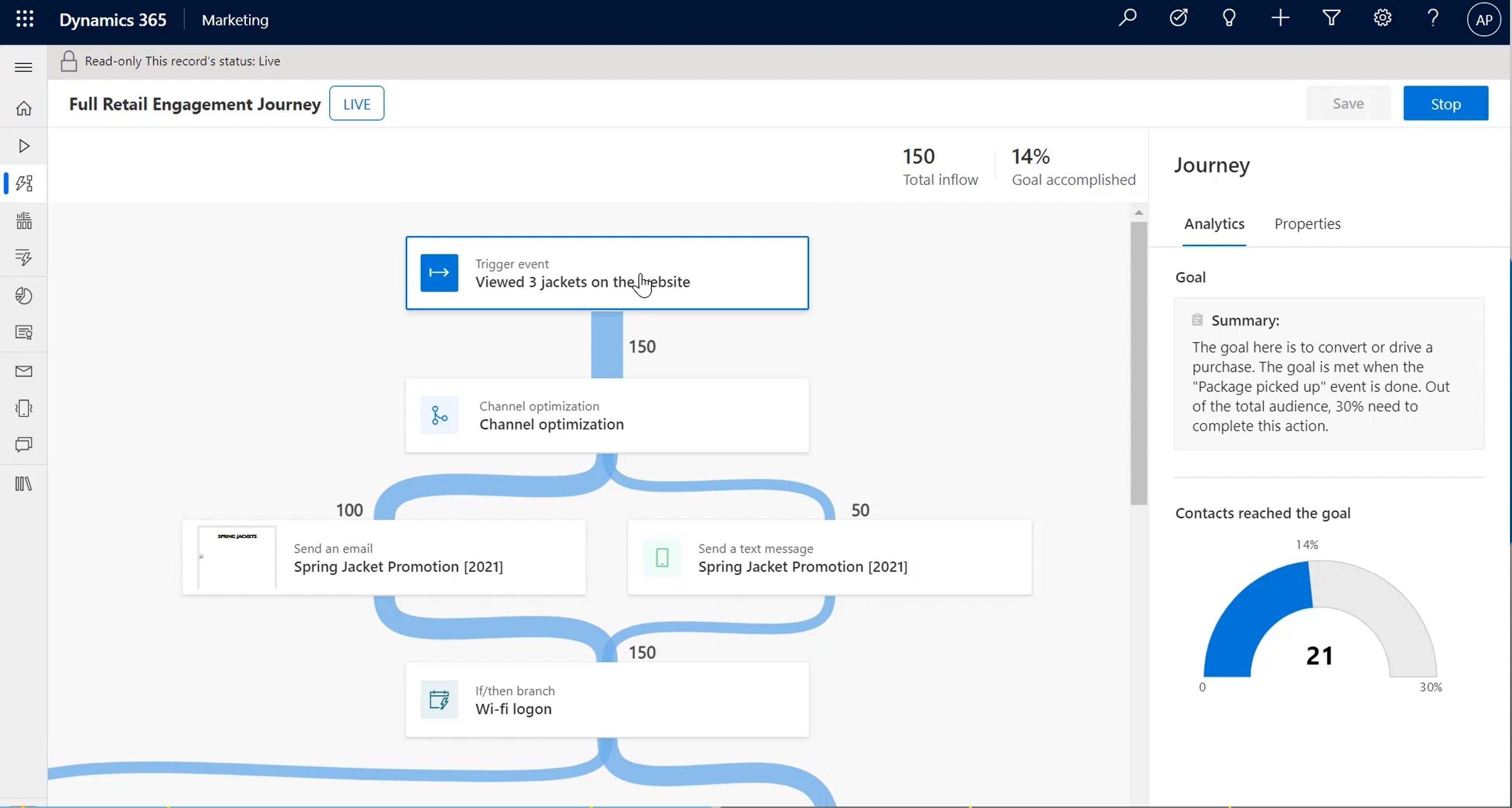
Customer Journeys in 365 Marketing is ideal for marketing automation and streamlining daily procedures. These would be tasks we’d want done with no direct involvement from the marketing team. We could design a system where the customer journey is mapped out, with various aspects and triggers accounted for. We then play that journey out and predict how it will unfold based on their responses. This means we change or adapt the process as the client’s needs evolve.
As any smart marketer will tell us, we need to map out the client’s path before we create campaigns and generate leads. This is an area 365 Marketing succeeds in.
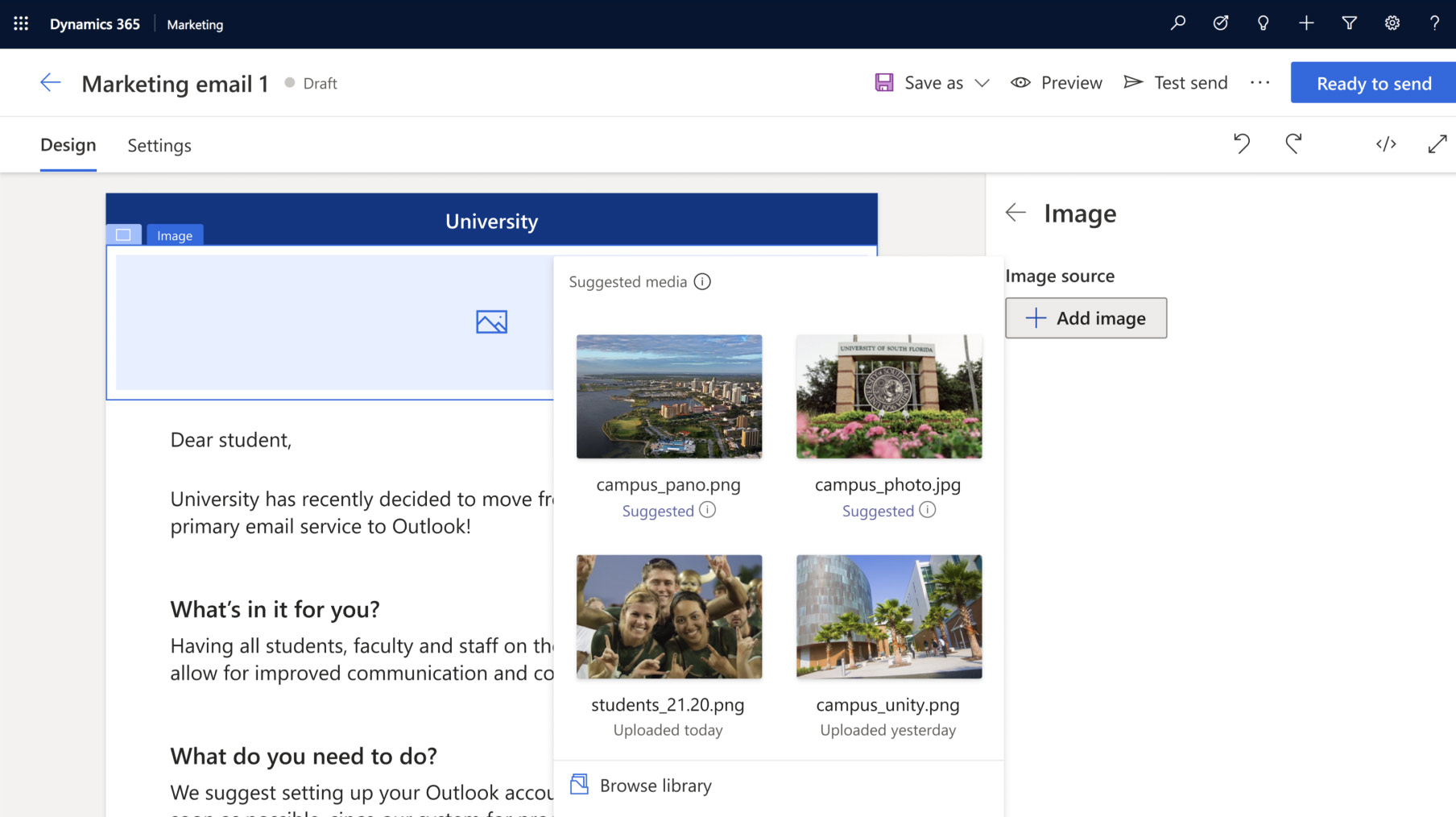
With the help of 365, we can distribute our campaigns through a variety of channels. It comes with templates and design tools that help us quickly create professional-looking branded emails, build lead capture forms, and establish dynamic landing pages. This is all with conversion in mind.
We can also develop SMS or text message and social media campaigns, which connect with Microsoft Social Engagement. This comes packaged with any of the suits’ CRM tools, which gives us more control over our social media marketing.
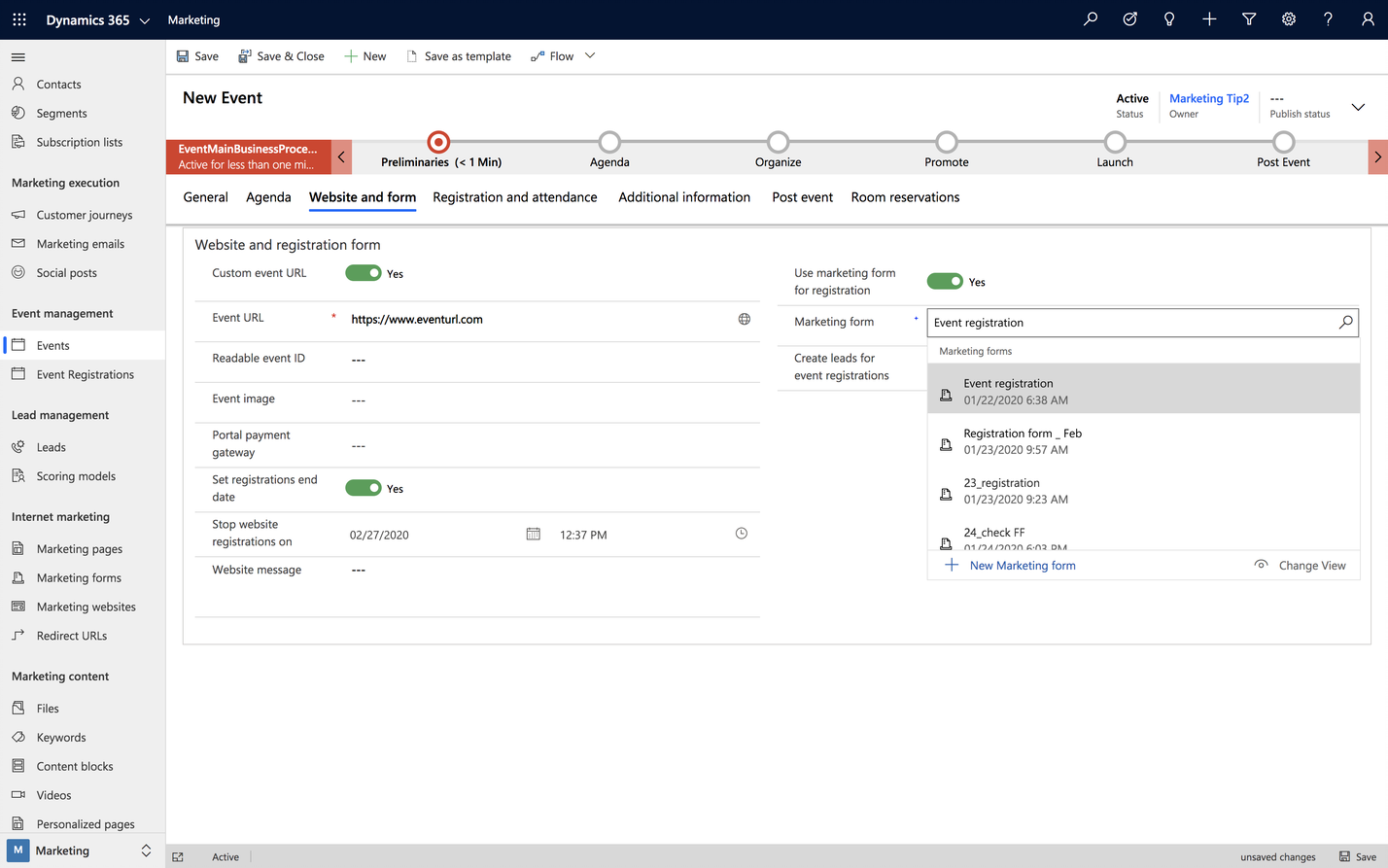
Modern marketing is all about providing value to current and potential clients. If a company does so by presenting events like conferences or seminars, 365 Marketing has several built-in tools to assist you.
The app’s event management capabilities include everything you need to create an event. It includes venue and speaker management, registrations, scheduling, and attendance tracking.
There’s even a portal management system that allows businesses to construct a customised event site. Here, attendees could manage their profiles, attendance, and registrations, and get all the information they need about speakers and event schedules.
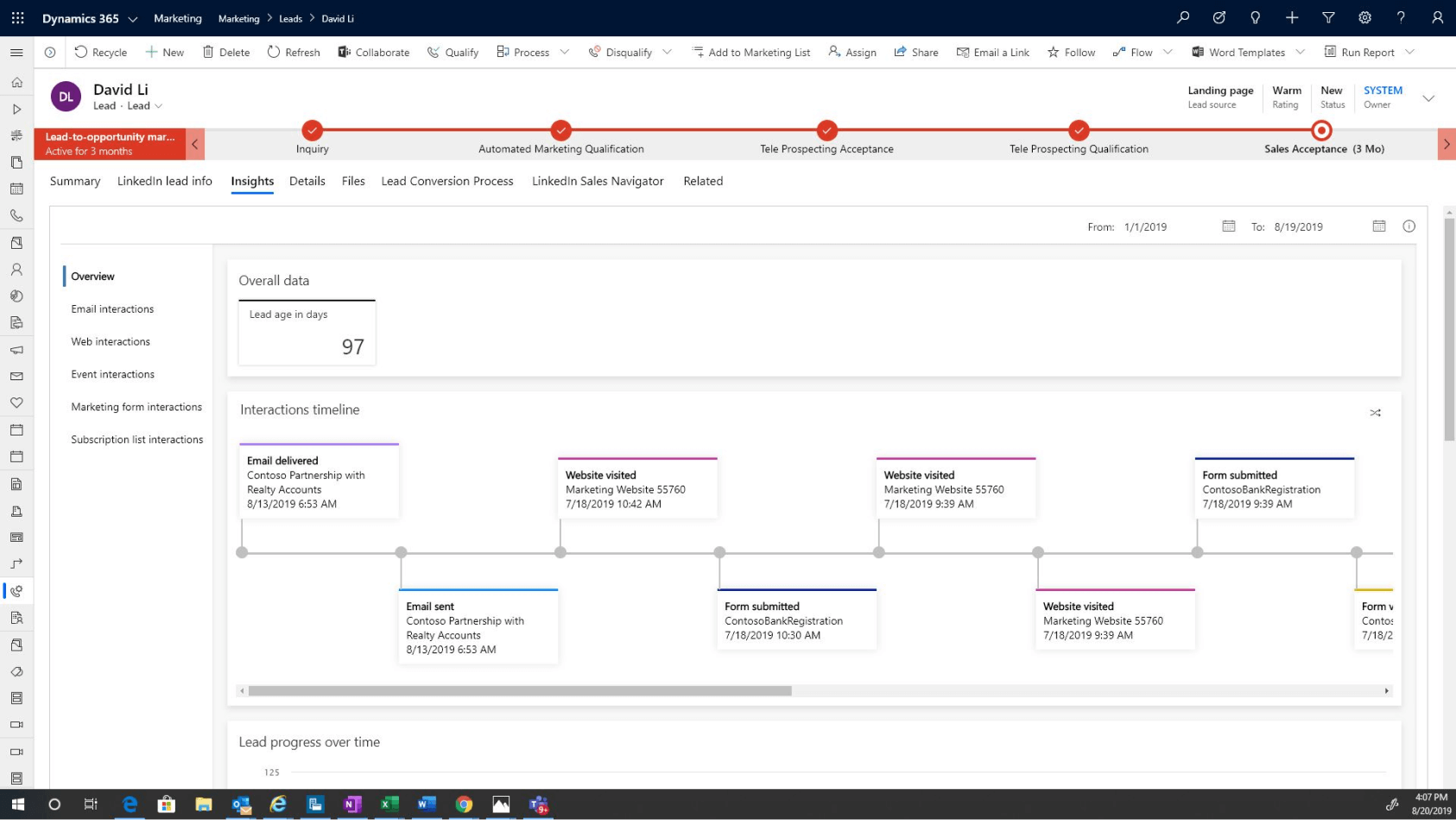
All marketing initiatives aim to produce leads. 365 Marketing comes with simple lead management features that make it easier to track, score, and nurture leads.
The app uses an intelligent, automated lead-scoring system that qualifies leads at every stage of the customer journey. This is based on predetermined rules, such as marketing email engagement, website visits, and event registration. This allows us to rate leads based on criteria that reflect what’s most important to us.
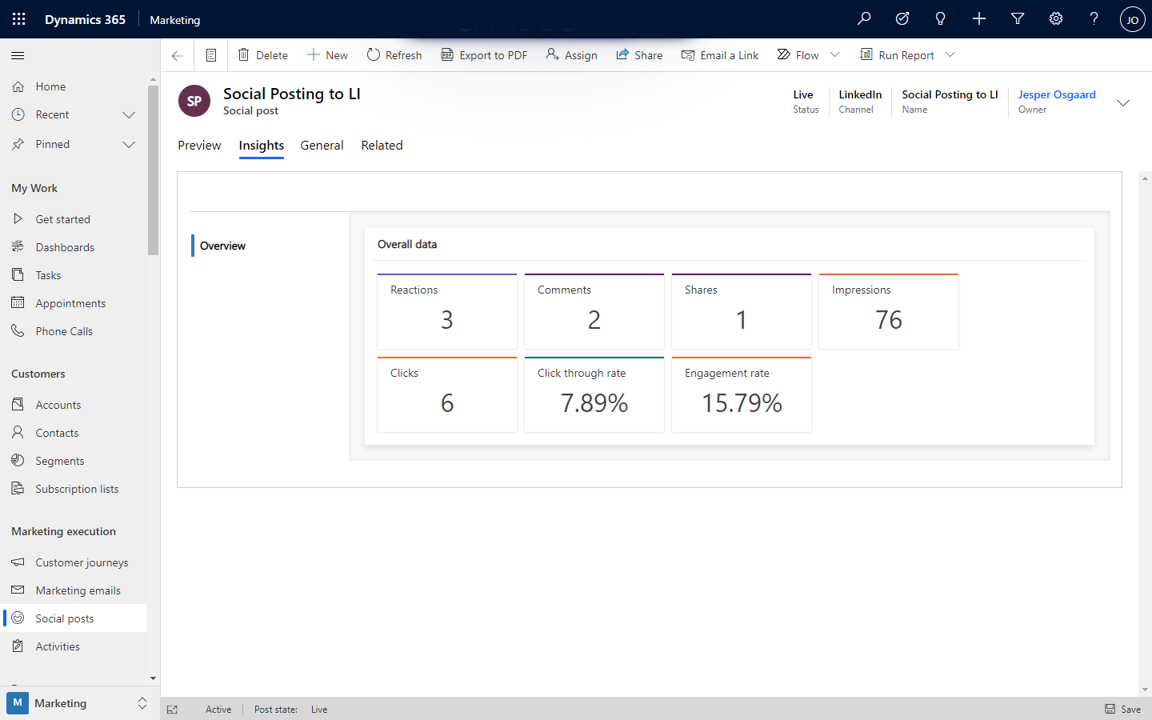
Analysing a campaign’s success is an important aspect of marketing, as it guides any further decisions. We want to gain knowledge and refine our marketing strategies as best we can. Insights are the way to do that. Besides the lead-scoring measures stated above, Dynamics 365 has powerful analytical tools capable of gathering and analysing data, as well as providing actionable insights.
Anybody can grow with the right marketing tools and know-how, and we can help them do that. With powerful flexibility and limitless possibilities, it’s clear that Dynamics 365 Marketing is the way forward. We help craft memorable experiences for your customers and nurture relationships. This is the value we offer and stand by.
We work with businesses to make magic and deal with many Microsoft products and services. Talk to one of our experts today and let’s see what we can do for your business.
To reduce costs, improve efficiency, and offer the customer service your clients deserve, you want to implement Microsoft Dynamics 365. Book a demo today to see how it can enhance your business.
The page you requested could not be found. Try refining your search, or use the navigation above to locate the post.
Over the last two decades, most global companies have had the luxury of digitising over time, so why is it such a buzzword in 2022? As technology changes, companies need to be agile enough to adapt to the changes. Digital transformation is not a once-off deal, it’s a process that’s constantly evolving.
If you’re looking to get ahead of the cultural shift, there are five digital trends that are set to take off in the near future.
Digital transformation is fundamentally shaping new ways for businesses to improve experiences, from internal departments to the end-consumer. It’s a cultural shift that involves adopting new technologies and harnessing the benefits to improve innovation, value, and efficiency.
Because of the pandemic, hybrid work models have been the forefront topic across the globe. We’ve had to change the way we work and interact with customers in all areas of business. It created a space where we had to shift the way we collect and integrate data while implementing a new space for employees to thrive.
Successful digital transformation can unlock business potential and help you increase your return on investments. Based on their transformational efforts, the following benefits highlight what most companies find rewarding.
Digital transformation optimises the way businesses collect and translate data. This means that departments can integrate raw data into insights across numerous touchpoints. This is fundamental to accessing a single view of the operations, customer journey, production, and finance. With this, you can use data-driven insights to improve workflow efficiency and enhance customer experiences.
From marketing and sales to C-suite, every department will be able to leverage off integrated applications, software and databases – a centralised portal that optimises business intelligence. This is a sure way to help keep employees connected while managing their day-to-day operations.
You can now unlock insights that meet the needs of your customers. This is the perfect way to create a more effective customer-centric strategy. Data-driven insights not only help you become more agile, but it also helps you make informed decisions, improve operations and discover new business opportunities with sufficient market evidence. If you’re an enterprise that places high-value on data, you’re set to see competitors use more data insight practices and collaboration.
One way to deliver a seamless customer experience is through digital transformation. Transformation affects the cadence of how your sales and marketing team discover new prospects. The challenge for most brands starts with the customer experience. Customers have limitless products and services offered to them day-to-day and it’s important to break through the noise. One way of enhancing CX is to give customers autonomous control over their data. When you provide the right features to meet customers’ needs, this will help your team manage expectations and earn long-term trust.
Trends predicted that by 2020, “83% of enterprise workloads” will run on the cloud. Approximately 41% of these workloads were predicted to run on public cloud platforms like Microsoft Azure, Google Cloud Platform and Amazon Web Services. Private-cloud-based services were predicted to have an additional 20%, while hybrid cloud platforms accommodated 22%.
Not only do these tools deliver effortless collaboration, they also help your enterprise move forward digitally. In order for your business to remain sustainable, the latest digital shift is a crucial one.
With this, upskilling and digital learning can be enforced and employees are able to take advantage of the benefits.
In the evolving digital space, Implementing the right digital assets will elevate your business from the inside-out. Getting your employees to help drive the mission is a crucial part of your transformation.
To achieve business objectives, finding an effective user adoption strategy is a great place to start. Whether it’s increasing CRM user adoption, implementing AI applications, or both — It’s important to find the relevant strategy that meets your business needs and employees’ capabilities.
Getting to know what’s ahead in the digital landscape will help you understand the why’s and how’s. Take note of the digital transformation trends that are set to take off in the near future.
Now more than ever, cybersecurity and data protection has become the next priority for 2022. During the course of the pandemic, customers spent more time on smart devices and companies were forced to move to hybrid work – having to adapt to new technologies in the process. As a result, a lot of companies recognise that automation and applications need to be secure in order to earn customer trust.
With that being said, customers are going to see a lot more high-placed value on security features that are being deployed to applications and software.
Small businesses are likely to adopt and automate processes going forward. It’s predicted that within the next year, automation will go as far as medium-to-large enterprises due to more accessible solutions. Whether you conduct business in manufacturing, market research or customer support, a number of businesses will start implementing a combination of digital assets into daily workloads.
Cloud-based services are incredibly scaleable, cost-effective and easy to use. As more enterprises move away from on-premise safekeeping, running applications on cloud platforms have become a ‘must-have’ solution. Where security is concerned, cloud platforms come with improved cybersecurity features that help keep data and sensitive information safe. In addition, your team will be able to collaborate more effectively and the cloud’s scalability allows big data to thrive.
Brought to you by the pandemic, hybrid working is set to become part of a permanent business model. What we can expect in the next year is an increase in employee expectations, and as the future of work heavily relies on connection – organisations will be forced to adapt. For instance, connecting virtually with colleagues is becoming a common hybrid solution for most. To drive productivity and employee retention, you will need to deliver digital-first solutions along with connected experiences that fit into the work from home space.
5. 5G and The IoT
Introducing the new age of mobile communication, the 5G network is set to define interaction on another level. When you invest in 5G and expand on the internet of things, your business will improve its cost and production. It will also become a concrete benefit for organisations that have adopted hybrid working. Greater flexibility, responsive networks and improved security are just some of the benefits that accommodate a connected future.
Within the last year, it was reported that 73% of businesses failed to meet the value out of their digital transformation efforts. According to forbes, 70% had failed adoption programs due to employee resistance. Businesses may understand the value of digital transformation but they’re not getting the value from these assets because of poor adoption practices.
Adapting to the following strategies will help you get the most out of your digital assets:
Companies are continuing to digitally transform their workforce. With the latest predictions, you’ll be set to deliver steady, high-value solutions to your customers — while fostering happier, more productive teams. In addition to this, you’ll be able to improve operational efficiencies every step of the way.
Explore the future scope of digital transformation. Learn how The CRM team can help you get there.
Transform your business
The page you requested could not be found. Try refining your search, or use the navigation above to locate the post.