No Results Found
The page you requested could not be found. Try refining your search, or use the navigation above to locate the post.
Over the last two decades, most global companies have had the luxury of digitising over time, so why is it such a buzzword in 2022? As technology changes, companies need to be agile enough to adapt to the changes. Digital transformation is not a once-off deal, it’s a process that’s constantly evolving.
If you’re looking to get ahead of the cultural shift, there are five digital trends that are set to take off in the near future.
Digital transformation is fundamentally shaping new ways for businesses to improve experiences, from internal departments to the end-consumer. It’s a cultural shift that involves adopting new technologies and harnessing the benefits to improve innovation, value, and efficiency.
Because of the pandemic, hybrid work models have been the forefront topic across the globe. We’ve had to change the way we work and interact with customers in all areas of business. It created a space where we had to shift the way we collect and integrate data while implementing a new space for employees to thrive.
Successful digital transformation can unlock business potential and help you increase your return on investments. Based on their transformational efforts, the following benefits highlight what most companies find rewarding.
Digital transformation optimises the way businesses collect and translate data. This means that departments can integrate raw data into insights across numerous touchpoints. This is fundamental to accessing a single view of the operations, customer journey, production, and finance. With this, you can use data-driven insights to improve workflow efficiency and enhance customer experiences.
From marketing and sales to C-suite, every department will be able to leverage off integrated applications, software and databases – a centralised portal that optimises business intelligence. This is a sure way to help keep employees connected while managing their day-to-day operations.
You can now unlock insights that meet the needs of your customers. This is the perfect way to create a more effective customer-centric strategy. Data-driven insights not only help you become more agile, but it also helps you make informed decisions, improve operations and discover new business opportunities with sufficient market evidence. If you’re an enterprise that places high-value on data, you’re set to see competitors use more data insight practices and collaboration.
One way to deliver a seamless customer experience is through digital transformation. Transformation affects the cadence of how your sales and marketing team discover new prospects. The challenge for most brands starts with the customer experience. Customers have limitless products and services offered to them day-to-day and it’s important to break through the noise. One way of enhancing CX is to give customers autonomous control over their data. When you provide the right features to meet customers’ needs, this will help your team manage expectations and earn long-term trust.
Trends predicted that by 2020, “83% of enterprise workloads” will run on the cloud. Approximately 41% of these workloads were predicted to run on public cloud platforms like Microsoft Azure, Google Cloud Platform and Amazon Web Services. Private-cloud-based services were predicted to have an additional 20%, while hybrid cloud platforms accommodated 22%.
Not only do these tools deliver effortless collaboration, they also help your enterprise move forward digitally. In order for your business to remain sustainable, the latest digital shift is a crucial one.
With this, upskilling and digital learning can be enforced and employees are able to take advantage of the benefits.
In the evolving digital space, Implementing the right digital assets will elevate your business from the inside-out. Getting your employees to help drive the mission is a crucial part of your transformation.
To achieve business objectives, finding an effective user adoption strategy is a great place to start. Whether it’s increasing CRM user adoption, implementing AI applications, or both — It’s important to find the relevant strategy that meets your business needs and employees’ capabilities.
Getting to know what’s ahead in the digital landscape will help you understand the why’s and how’s. Take note of the digital transformation trends that are set to take off in the near future.
Now more than ever, cybersecurity and data protection has become the next priority for 2022. During the course of the pandemic, customers spent more time on smart devices and companies were forced to move to hybrid work – having to adapt to new technologies in the process. As a result, a lot of companies recognise that automation and applications need to be secure in order to earn customer trust.
With that being said, customers are going to see a lot more high-placed value on security features that are being deployed to applications and software.
Small businesses are likely to adopt and automate processes going forward. It’s predicted that within the next year, automation will go as far as medium-to-large enterprises due to more accessible solutions. Whether you conduct business in manufacturing, market research or customer support, a number of businesses will start implementing a combination of digital assets into daily workloads.
Cloud-based services are incredibly scaleable, cost-effective and easy to use. As more enterprises move away from on-premise safekeeping, running applications on cloud platforms have become a ‘must-have’ solution. Where security is concerned, cloud platforms come with improved cybersecurity features that help keep data and sensitive information safe. In addition, your team will be able to collaborate more effectively and the cloud’s scalability allows big data to thrive.
Brought to you by the pandemic, hybrid working is set to become part of a permanent business model. What we can expect in the next year is an increase in employee expectations, and as the future of work heavily relies on connection – organisations will be forced to adapt. For instance, connecting virtually with colleagues is becoming a common hybrid solution for most. To drive productivity and employee retention, you will need to deliver digital-first solutions along with connected experiences that fit into the work from home space.
5. 5G and The IoT
Introducing the new age of mobile communication, the 5G network is set to define interaction on another level. When you invest in 5G and expand on the internet of things, your business will improve its cost and production. It will also become a concrete benefit for organisations that have adopted hybrid working. Greater flexibility, responsive networks and improved security are just some of the benefits that accommodate a connected future.
Within the last year, it was reported that 73% of businesses failed to meet the value out of their digital transformation efforts. According to forbes, 70% had failed adoption programs due to employee resistance. Businesses may understand the value of digital transformation but they’re not getting the value from these assets because of poor adoption practices.
Adapting to the following strategies will help you get the most out of your digital assets:
Companies are continuing to digitally transform their workforce. With the latest predictions, you’ll be set to deliver steady, high-value solutions to your customers — while fostering happier, more productive teams. In addition to this, you’ll be able to improve operational efficiencies every step of the way.
Explore the future scope of digital transformation. Learn how The CRM team can help you get there.
Transform your business
The page you requested could not be found. Try refining your search, or use the navigation above to locate the post.

The CRM Team, in partnership with ITWeb, conducted a Digital Technology Adoption survey in May 2022 to find out how effectively South African companies and people are adopting technology in different industries.
The survey was met with great participation with a total of 209 valid responses recorded.
From these captured responses, the key findings were that only 53% of the respondents stated that they had the right software to serve their customers, and 32% said they did not.
49% of the survey respondents stated that they had a digital adoption strategy for at least three years. While 20% of respondents reported having a digital adoption strategy for one to three years, and 13% of respondents said that they are not currently planning to deploy a digital adoption strategy. 12% said they were just about to roll out a digital adoption strategy, while 6% said it had been in place for less than a year.
The survey asked participants how familiar they were with the ADKAR model of change management. 57% said they had no idea what it was. 25% of respondents are aware of ADKAR but have never used it, while 12% stated that they use ADKAR to manage change on various projects.
According to the respondents, when asked which factors assisted their organisation’s adoption of digital technologies, 22% said online training, 14% said cross-functional collaboration, 14% said integration with customer experience, and 12% said change management practices.
There were five main points cited by respondents as the primary drivers for adopting digital technology: increased agility (15%), easier customer service (14%), better innovation (14%), improved departmental collaboration (12%), increased revenue (10%), and reduced non-value-added work (10%).
Within their digital adoption strategies, respondents plan to implement the following technologies:
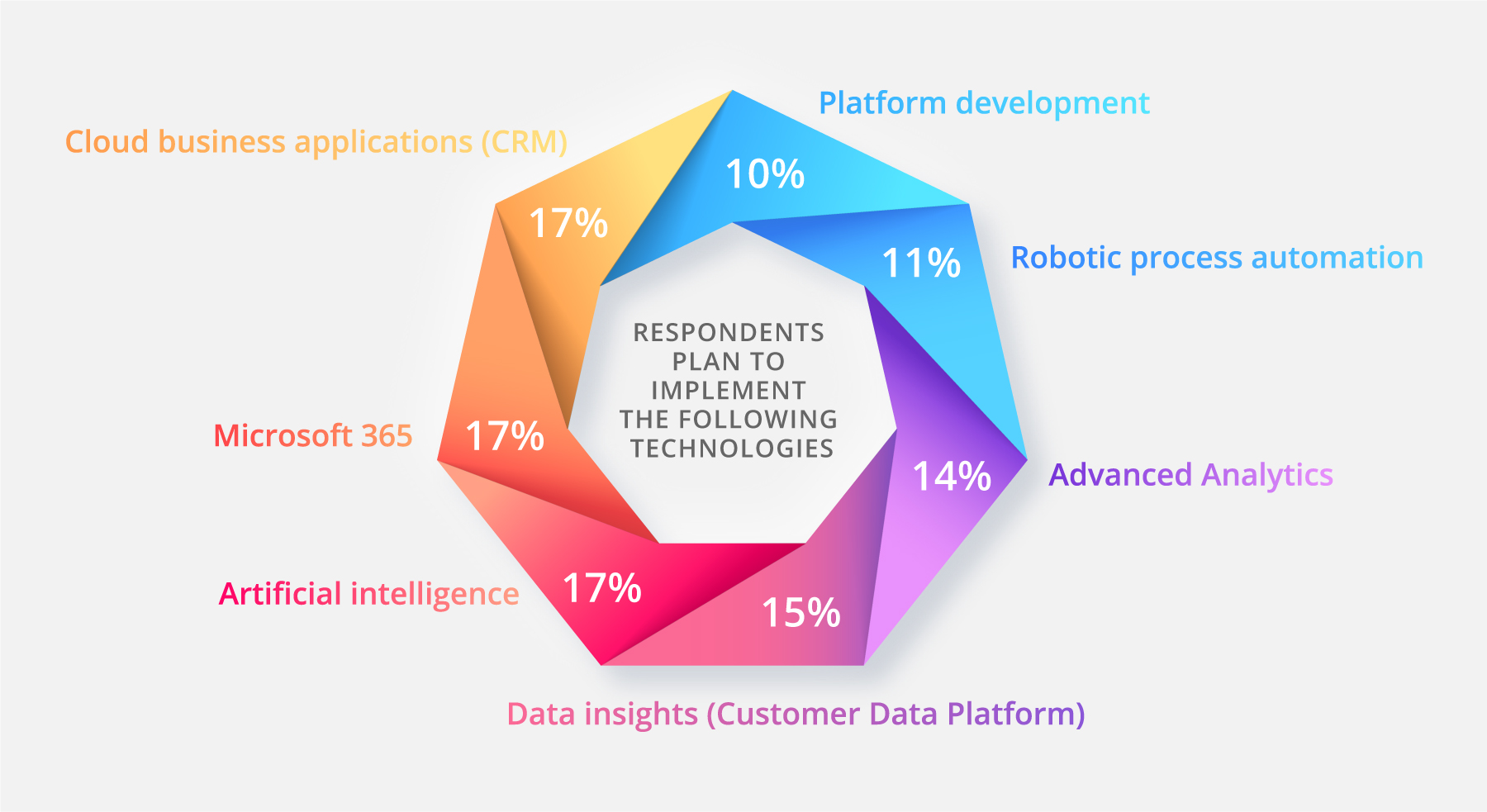
According to the survey findings, the top 3 drivers for digital technology adoption are customer experience improvement innovation, and process improvement.
Respondents responded that the most common barriers to digital transformation are: economy (29%), lack of resources (21%), and lack of digital business skills (17%).
The survey results indicate that CEOs are most likely to adopt digital technology (32%), followed by CIOs (21%).
Thank you to everyone who participated in the survey we value your feedback and we received quite insightful results. The participants who completed the survey stood a chance to win a R3000 Takealot voucher. A draw was conducted from the 209 valid participants, and Riaan Myburgh won the voucher! A huge congratulations to Riaan.
The page you requested could not be found. Try refining your search, or use the navigation above to locate the post.

Youth Month is tied in with remembering the young people who partook in the Soweto Uprising and celebrating the young people of today. To end off youth month, we spoke to the youngest member of The CRM Team, Johan Nel, to hear his thoughts on the present status of the young people of South Africa and what he trusts the future will bring for youngsters in this country.
What has kept you headed to prevail quite early in life?
I would give a great deal of credit to my father. My father has been my wellspring of motivation to succeed – he imparted in me that nothing comes free in life and that hard work pays off.
What does success look like to you?
Success to me is waking up every day and looking forward to going to work. Money does not measure success – a sound working environment means the most to me.
Being a young person with a job and knowing how high youth unemployment is in South Africa, how does that make you to feel?
Privileged without a doubt, yet additionally sad. Having a steady work and a rooftop over my head causes me to feel special yet miserable that there are individuals out there who do not have similar privilege.
How would you think the government needs to fix the unemployment rate among youngsters?
The government, first and foremost, has to make a more straightforward way for individuals to become business visionaries. There has to be a simpler way for individuals to begin their businesses.
Secondly, the community should work together to drive employment. Perhaps if the community would help the less privileged to apply for work, help the less fortunate to get access to sites such as LinkedIn and help them apply for work then surely that will make some sort of difference.
Tertiary institutions also need to furnish studies with experience. When we finish our studies all we get a piece of paper, meanwhile organisations insist that we should have experience, even for entry-level positions.
There is no guidance to prepare students for what comes after finishing your studies, you are left in the deep end to fend for yourself.
In your opinion, how does the future of youngsters in this country look?
Difficult. There is insufficient support for young people in this country. Employment seemingly will become more difficult. The competition in the workplace is becoming tough, employers now seek individuals with multiple expertise to do various tasks rather than employing many people to do those duties.
In the event that you could offer the young people of South Africa any advice, what would it be?
What change do you want to witness in the young people of South Africa?
I might want to see youngsters be versatile. To face challenges and advance as much they can.
Where do you see yourself in the future, and how do you intend to get there?
I want to further my studies so I can bridge the gap between being a delivery manager and a developer. Developing is what I am currently inclining towards.
Like Nelson Mandela once said, “The youth of today are the leaders of tomorrow.” At The CRM Team, we celebrate our young people and seek to uplift those who are struggling to find direction. We hope you will be inspired by this article.

Johan Nel – Delivery Manager
Johan is a Dynamics 365 Delivery manager with experience in various industries in the last 5 years. He specializes in Agile processes and has been running projects with this methodology for the last 5 years. He has played various roles ranging from Analyst to Project Management.
The page you requested could not be found. Try refining your search, or use the navigation above to locate the post.
The CRM Team will be hosting a free webinar titled Adapting To Change: User Adoption & Technology, helping business leaders optimise their software investment through effective change management.
This topical session will illustrate how effective change management and training improve user adoption and help maximise investment in new solutions. Whether one is planning to implement a new solution or already has a solution that users are failing to embrace, this user adoption, training, and change management session will outline how to improve adoption through proven methodologies.
Mark James, head of training at The CRM Team, says new technology solutions may promise to improve your business, however, without user buy-in and adoption, your ROI and business impacts may be disappointing. “Imagine you have to complete a series of tasks in a dark room. The fact that there is low to no visibility makes it almost impossible to execute your tasks effectively.”
“At the risk of stating the obvious, it might be easier if you could simply flick a switch and light up your playing field. Creating the ideal systems solution for all your users and stakeholders can be just as challenging, but you can light up your playing field by consulting and involving key users in the process, from planning, through execution, all the way to realising a return on your investment,” he explains.
Discover what works and what does not in change management and user adoption programmes. Join The CRM Team and get an overview of the most effective Adoption and Change Management strategies to accelerate one’s digital transformation.
Delegates will see first-hand how to rapidly release the value from your technology investments as these change management specialists share their insight and practical tips for maximising user adoption.
The webinar will be held at 10:00 on 21 June 2022, for more information visit https://www.itweb.co.za/webinar/crm-team-adapting-to-change-user-adoption-technology/
The page you requested could not be found. Try refining your search, or use the navigation above to locate the post.

Sales and marketing alignment, or “smarketing” as some like to call it, is essentially getting these two teams to cooperate as one; working towards a common goal – generating and increasing revenue in the long run.
Think of your business as one big family. As with real families, there are usually two or more relations (like siblings) who are constantly bickering, and in this instance, Sales and Marketing can be considered the corporate siblings.
Aligning these two teams is an opportunity to grow your business. As a sales or marketing manager (or parent in this instance), it can be frustrating to constantly try and keep the peace between the two teams, especially when your time could be better spent on more productive tasks.
Getting these “siblings” to collaborate and listen yields a brand new invention – or simply creates a much more harmonious working environment. Which in turn leads to a healthy impact on organisational growth (see more on this infographic by Wheelhouse advisors).
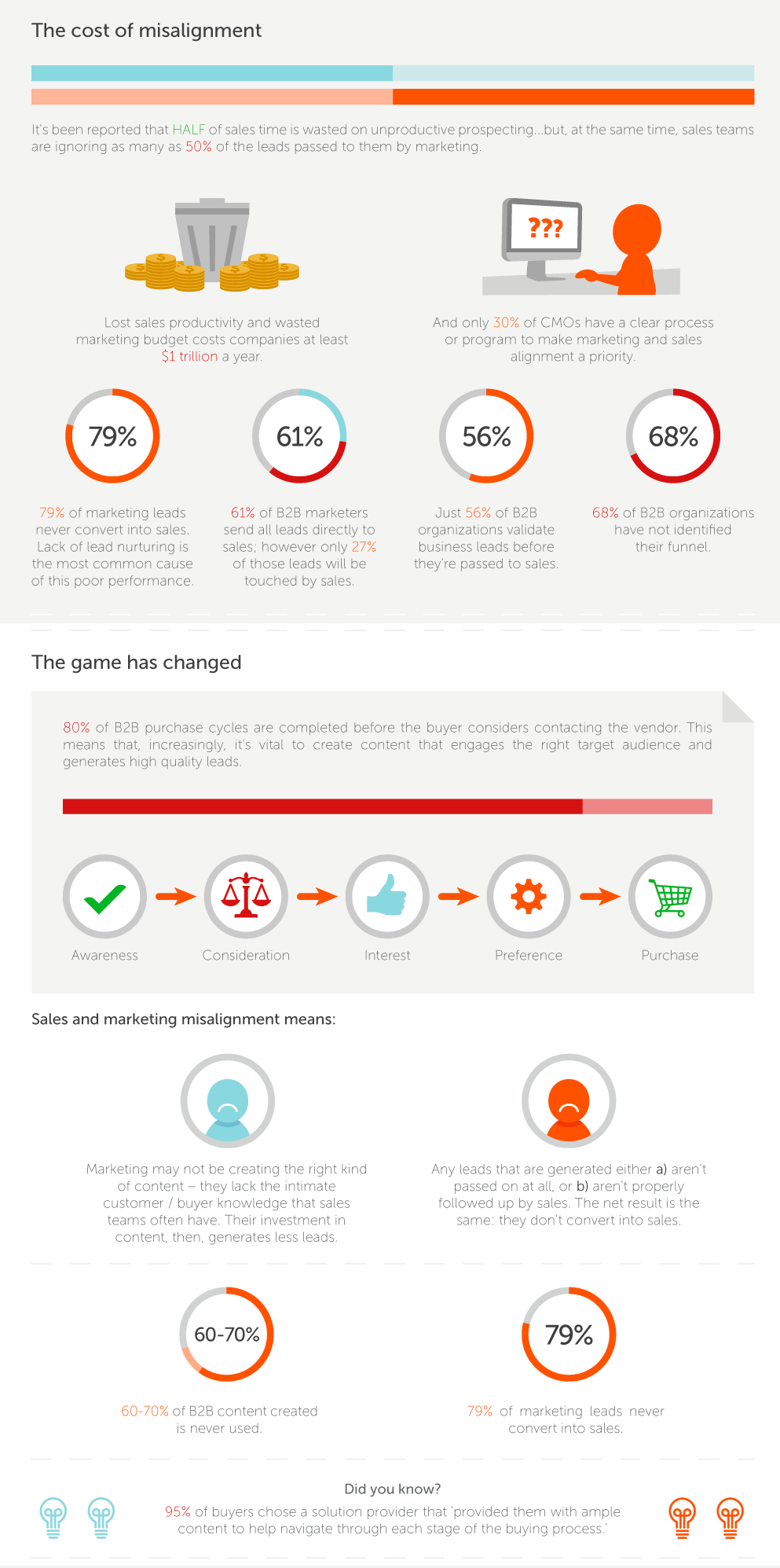
Did you know that $1 trillion of revenue is lost annually due to marketing misalignment?
Let’s explore some ways on how to better align your marketing and sales teams.
Sales and marketing teams are often siloed through different offices, technologies and goals. By (literally) breaking down the walls between these two teams, you can combine the sales and marketing funnels into one process for both teams. How? With Microsoft Dynamics 365 for Sales and Marketing. Both of these software solutions are based on the same platform so that both teams can share and access data and business processes – simplifying the alignment between sales and marketing teams.
As the leader of your team, you should practice what you preach. Openly praising (or criticizing) another team in front of your own will set the precedent for them to do the same. Small, simple ways to start the alignment process are by giving credit where it’s due; openly collaborating with other team leaders and carrying their contributions back to your own team. When your team sees your cooperation with the other, the effect will trickle down.
Another way to align the sales and marketing teams is to simply communicate with one another. It can be as quick as grabbing a coffee together or through scheduled meetings. This essentially helps the team gain in-depth knowledge of one another’s challenges. Attending meetings together lets teams know how each one is doing with their goals and how they can support one another. For example, the marketing team can share what content they’re creating and promoting, while the sales team can help marketing improve their lead-generating skills.
In order to generate strong quality leads, both the marketing and sales teams need to align on what the ideal client looks like. If this is not clear, marketing campaigns could be skewed and sales will waste time chasing misinformed leads. Assessing your buyer persona together ensures more accurate marketing campaigns and higher close rates for the sales team, and ultimately increased revenue. A win for everyone!
Smarketing needs to head toward the same goal with the same coordinated messaging, and as long as each department is doing this, everyone will be aligned. Keeping an open feedback loop to ensure everyone is on the same page is imperative to achieving alignment and organisational growth. For example, should a prospect or customer ask for content that doesn’t exist (yet), there should be a simple way for marketing to receive this nudge and add it into their content strategy. Similarly, sales should ensure they’re using defined brand tone/messaging when prospecting. This type of open communication drives improvement across both teams.
Though it may seem to be the most obvious route to alignment, motivation hardly seems to be the first thought that comes to mind. By motivating everyone on your team – from the CEO to the new intern – you’ll get a better understanding of the financial value of their work.
Creating similar KPIs and goals is a great way to align smarketing. Having the same goal gets both teams working and strategising together, providing a more holistic approach to marketing. This also creates a seamless transition from marketing to sales, preventing broken messaging that could result in losing a potential lead. When conversion rates and lead value is measured and influenced by both teams, this would be a great key performance indicator (KPI) smarketing can work towards.
There will naturally be different KPIs for each team and colleague, but for true smarketing alignment, there needs to be a general understanding of what each team wants to achieve and how they can work together to achieve it. Perhaps it comes down to the sales team reducing the number of touchpoints between converting a lead to a sale. By collaborating with the marketing team, they can create succinct workflows that allow leads to pass between marketing and sales, as and when necessary.
So, there you have it – tried and true tips for aligning your sales and marketing teams; these tips should help your teams get along effortlessly. But remember, implementing the same tools such as Microsoft Dynamics 365 for Sales and Marketing, having the same processes and aligning your goals is key. When one team is working with leads from the other, data can get lost on both sides and teams can’t see where the lead originated from, track its progress or provide feedback on trends surrounding these leads.
Now that there’s virtually nothing holding you back, see what you can do to improve smarketing alignment today – we suggest starting with a coffee, a chat and Microsoft Dynamics 365.
Transform your business
The page you requested could not be found. Try refining your search, or use the navigation above to locate the post.