No Results Found
The page you requested could not be found. Try refining your search, or use the navigation above to locate the post.


– A quick Google search defines inertia as “the tendency to do nothing or to remain unchanged,” while Wikipedia defines it as “the resistance of any physical object to a change in velocity.” This includes changes in the speed or direction of motion. One element of this quality is the tendency of things to continue travelling in a straight path at a constant speed in the absence of external influences.” It should come as no surprise, therefore, that individuals, by definition, oppose change. It’s perfectly normal and natural. Expect some resistance when implementing a new system in an organization; it’s natural, but for goodness sake do something about it. Apply the force that causes them to shift direction.
Whether you believe in creation theory, are a big-bang fan, or anything else, there is one unavoidable truth:
Even the most ideal system is vulnerable to failure due to an internal element that far too many businesses overlook and disregard in their planning.
Who is the perpetrator? If you are not proactive, the same people for whom you made this paradise may corrupt it and turn it into a wasteland.
Your most cherished users are your greatest potential danger.
Simply put, we must reduce this risk…
History has shown that implementation efforts will fail in the absence of a strong user adoption strategy.
I just bought a Haval Jolion Super Luxury.
To replace my 2015 Volvo XC60 T6 AWD R-Design Polestar, I would have loved a Volvo XC40 or perhaps the considerably smaller Volvo S40. Any vehicle would have sufficed as long as it was a Volvo, but my budget protested loudly. I didn’t know anything about the Haval brand. So I conducted my research and found some extremely intriguing things about these vehicles, to the point where I was so pleased that I tracked down a car 500km away and had it delivered to me within 5 days, despite the 3-month waiting list for brand new vehicles. Because I was loyal to the brand I have owned before, I almost missed out on what I now consider to be the finest vehicle I have ever owned.
The point is that no matter how elegant and technologically advanced a car is, if no one embraces and utilizes it as soon as it leaves the factory, it may as well be a bicycle. This is a pretty typical end-user problem. Why should I use Excel when I already have this handy calculator? I don’t require SQL because I keep all of my client information in Excel. I don’t need the Power Platform because my SQL database has all of the information I want. People are naturally resistant to change from what they have gotten accustomed to and feel at ease with.
Alan Lee-Bourke is a Principal Consultant in Microsoft’s Adoption and Change Management Global Practice, a Prosci Certified Advanced Instructor, a Prosci Experienced Practitioner, and the Director of the Scotland Association of Change Management Professionals.
In a recent article titled “7 REAL REASONS WHY TECH PROJECTS FAIL,” he provides the following frightening statistics:
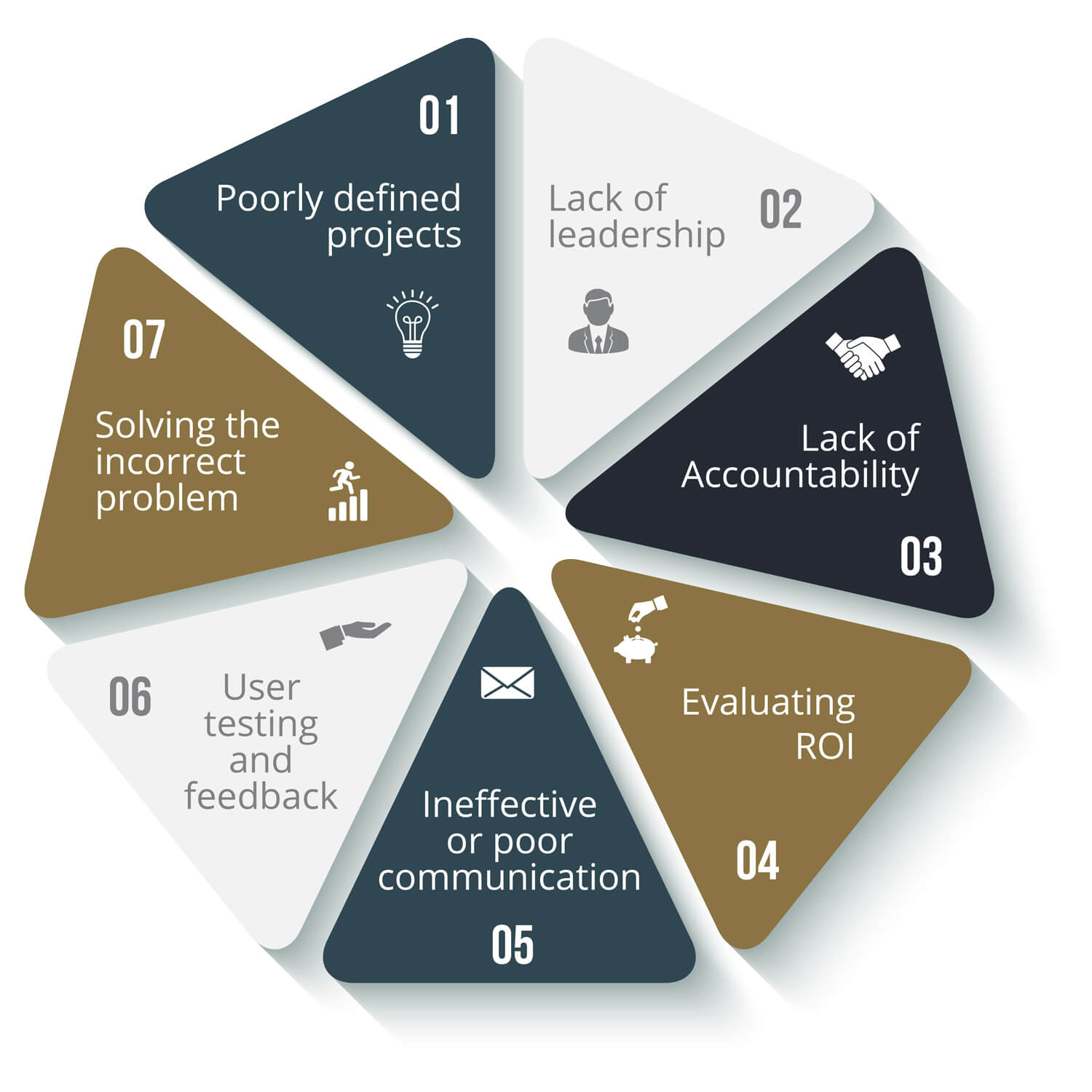
1. Poorly defined projects – this definition should cover more than just WHAT we are doing, but also:
– Why are we doing this?
– Why are we doing it right now?
– What will happen if we don’t?
2. Lack of leadership – An implementation project should never be confined to the IT department. Implementation is a business project which needs a strong key sponsor, who is active and visible – and one who will build a sponsor coalition and communicate effectively.
3. Lack of Accountability – Businesses simply must take responsibility for managing the change process. In our world that means getting users through the ADKAR process for them to make the project successful.
4. Ineffective or poor communication — Effective communication is crucial in change management.
5. User Testing & Feedback – We must focus on the end-user’s DESIRE to step out of their comfort zone and use the system.
6. When we evaluate ROI – When we go live, we will begin to see genuine business benefits from a people-dependent project.
7. Solving the incorrect problem — What are the issues, based on what your end-users are telling you? To put it another way, why would they want to switch to the new system?
At The CRM Team, we believe that to gain and maintain credibility, User Adoption Strategies must be actively led from the top down. The higher up, the better. The key sponsor should preferably be a member of the executive team – the CEO, MD, CIO, or CTO – and their message should be: “I am completely in support of this initiative.” The primary sponsor should then be supported by a Sponsor Coalition comprised of managers and supervisors who are in charge of influencing user behaviour in the departments affected by this project.
It is vital that the Key Sponsor and the Sponsor Coalition drive this change and emphasize the importance and urgency of the change. Their personal engagement is critical to the project’s success.
Reward and Recognition
A strong Recognition and Reward system would motivate and inspire users and fuel the User Adoption Drive.
The Recognition and Reward strategy can be built around key metrics such as
In terms of sales:
In terms of Customer Service:
Just to name a few….
These are small steps to ensuring optimal user adoption. Each step building on the momentum and energy generated by the previous one.
Conclusion
Friedrich Nietzsche stated many things, most of which I disagree with, but one of them remained with me: “He who would learn to fly one day must first learn to stand and walk and run and climb and dance; one cannot fly into flying.”
On the perilous journey toward User Adoption we must be careful to take each of these little steps to ensure that our system implementation does not crash and burn, but that it will fly and take your organization to new heights.
When you succeed, we succeed!

Mark James – Head of Training & User Adoption
Mark has been a Microsoft Certified Trainer for many years and has been training Dynamics since CRM version 4.0.
He specialises in Dynamics 365 end-user training and has trained across the UK, Africa, and the Middle East. Mark is proficient in Microsoft Dynamics 365: Sales, Service, Deployment, and Customization & Configuration.
Transform your business
The page you requested could not be found. Try refining your search, or use the navigation above to locate the post.
Did you know The Harvard Business Review conducted a study that showed 50 per cent of consumers would trust AI to provide financial services?
The business and finances world is in constant evolution and you want to be sure you can keep up. Financial services institutions have to be on the lookout for the latest trends so that they can offer the kind of services their clients want.
If you are afraid of falling behind, there are some trends and emerging technologies in the financial service industry you need to watch. Read on to learn what they are and how they can benefit your services.
The newest generations do not want to be treated like a number or even as a segment of the population. They want personalised financial services.
Hyper-personalisation uses big data to find ways of making the financial experience of a client unique. It works with what the particular client needs at that time and does not use a one-size-fits-all process.
Hyper-personalisation can be as simple as allowing clients to set up automatic mobile payments. It can also be as complex as suggesting investments the individual would be interested in making.
With this kind of personalisation, you will be pleasing the client. You will also be building up long-lasting relationships that will ensure the person relies on your services and your financial institution.
Digitisation is the rage in the financial industry. Technology comes in to provide gaps in the industry. This is why banks are cutting down on spending in physical branches and instead investing in self-service digital options.
The customer base depends on mobile and online banking. Smartphones are making it easier than ever to offer targeted services to individuals.
Customer service has also taken a leap into the digital world. Clients expect to be able to chat with someone online or resolve issues via apps. In 2020, the need for contactless transactions and digital options increased and that is only going to continue.
Data protection laws have increased with the trend of financial services heading toward digitalised options. Regulatory compliance is a concern that financial industries were not sure how to tackle.
AI is the solution. Artificial intelligence for anti-fraud services, as well as data analysis and reporting increase security. AI completing repetitive tasks can increase operational efficiency, as well. Even robo-advisors have become more popular in banking and financial services.
Not only does AI offer a great customer experience, but it also frees up the institution’s workforce to deal with more complex activities that AI cannot perform. Robotic process automation is the future.
Banks are beginning to collaborate with FinTechs to improve and grow their digital experience. FinTech companies were seen as the competition at first. Since they could offer the services that the slower-evolving banks could not, they are now part of the evolution of the banking and financial services world.
FinTech companies provide loan servicing, marketing, administration, and other services. This lets the bank offer banking services and products that work with the latest technologies. FinTechs provide the chance of constant innovation.
A challenge that banks face is ensuring they can offer whole bank loyalty even for clients who only have credit cards with them. The client-bank relationship has to extend beyond credit cards. The bank has to provide all the essential services that a customer needs.
You want to be able to offer excellent services throughout the entire relationship between a customer and you.
This is an excellent option that providers digital transformation and operation efficiencies. With biometric access controls like fingerprints and facial recognition, it can be simple for customers to make payments and perform other services solely through mobile options.
Financial transactions many times cross over to retail, utilities, and even healthcare services. It can be frustrating and slow for clients to have to switch back and forth between apps and other websites. Providing cross-platform services is essential to solve this.
You can do this with embedded payment services. Turn to mobile pay or hybrid wallets to allow your clients easy transactions without having to switch back and forth between sites or apps. The financial services industry will greatly benefit from cross-platform services.
Chatbots can save, on average, 4 minutes on every interaction. This makes them a huge asset to any financial services provider.
Chatbots provide the 24/7 interaction that clients expect. Financial markets can also benefit from the quick resolutions to problems that they offer. They maximize the customer experience and can allow for customer feedback, as well.
Blockchain can help ensure the safety of customers’ payment transactions. It can also help investment banks with challenges they may face.
Blockchains also ensure data security.
2020 proved that trading does not have to happen on the trading floor. This has opened up opportunities and options. There is now a need to separate financial activities from physical locations.
Zero trust networks can allow for these transactions and are not tied to any location. They still remain secure.
When 2020’s shutdown occurred, there were backlogs of loan document processing. It was taking too long to get the loans reviewed and approved.
The data system was too slow to respond to customer needs. It could not provide the real-time information needed. Stronger, faster, and secure technology systems for data are vital for financial institutions.
You want customers to be satisfied with your business. Financial services can always evolve and you want to be certain you are at the cutting edge of improvements.
Contact us today to revolutionise your business!
Transform your business
The page you requested could not be found. Try refining your search, or use the navigation above to locate the post.

CRM technology is vital for your company, but how can you implement it in an efficient and user-friendly manner?
One of the Microsoft products that are making a difference is Microsoft Dynamics 365.
Read on to see how it can impact your company.

Microsoft Dynamics 365 makes it easier for mid-market companies to engage with customers, team members, and prospects. It is the only cloud-based option that offers what a company needs in terms of CRM and enterprise resource planning (ERP).
It unifies all of the CRM apps you utilize, making the sales process much simpler and more streamlined. It gives employees the tools they require to improve customer relationships, customer experience, increase productivity and sales.
Since it uses both CRM and ERP technology, it makes communicating internally, as well as with customers, much easier.
Microsoft Dynamics 365 brings digital intelligence to all business processes and can be the digital transformation you want for your company.
If you are considering implementing Microsoft Dynamics 365, it’s important to know what benefits to expect. Let’s dive deeper into what it offers.
Not only is it simple to implement, but you can also use it in the cloud or in a hybrid cloud setting. Microsoft Dynamics 365 has an intuitive user interface that is incredibly clear.
Users can create personalized workspaces that are activity-based. This enables them to manage assets and processes. It is similar enough to Office 365 where users will quickly feel like they know how to use the program. Therefore, reducing the stress of new software implementation.
If your company requires employees to have their own devices, this software is ideal. Employees will be able to access all of their information through its cloud-based functions.
This software comes in many languages and has country-specific functions for more than 50 countries.
Dynamics 365 fully integrates with Office 365, allowing the simple use of Outlook, Power Bi, and SharePoint.
It is quick and efficient to move between apps when you use Microsoft Dynamics 365. You do not have to worry about your employees taking more time to input customer data into other platforms. You also do not have to provide added personnel re-training.
This software will give you the complete picture of your business that you can analyze and improve on.
Microsoft Dynamics 365 collects a vast amount of data from clients. It can analyze how they interact with certain brands, what kind of websites they visit, and what communities they belong to.
You can expect to receive information on brand loyalty and buying patterns when you use the BI tool. This offers invaluable help for customer service representatives.
With all of this data in their hands, customer service representatives will be able to have personalized interactions with customers. This is beneficial to the client as well as to the business.
Microsoft Dynamics 365 has built-in analytic tools and real-time insights. Azure Machine Learning, Cortana Intelligence, and Power BI are all embedded in the software.
Cortana and Azure and their algorithms take descriptive statistics and can use them for predictions on the opportunities your business should take.
With these tools, you can get predictive insights and see hidden trends. The business application of these pieces of data are invaluable.
When you make a decision, you will do it based on accurate data reports. Not only is this better for your business, but it also offers much more responsive customer service.
Data privacy is a growing concern, but it is one less thing you will have to worry about with Microsoft Dynamics 365. Although it is a cloud-based solution, Microsoft Azure offers top-level cybersecurity.
It has disaster recovery and technical support available for twenty-four hours. With physical data centers, service hosting platforms, and network connectivity, you can get the help you need.
With software that allows you to reduce the sales cycle, you can expect fewer costs. It offers the real-time insights employees need to answer questions and make decisions during the sales process.
Its advanced automation functions also help identify redundancies in resources and processes. This goes a long way to save on costs.
Since Microsoft Dynamics 365 uses the cloud for its functions, you also save money on having to maintain your own servers and hardware.
Dynamics 365 has many built-in workflow tools and modules. They can help you automate functions and tasks across marketing, customer service, field service, sales, and project service.
If you find that the built-in tools are not offering exactly the functions that you need, you can customize them. You can use the customization tools in the program to add new fields and new objects.
You can also expect flexibility in the program’s architecture. There are pricing tiers which allow you to customize the program to your budget and team size.
Like most other cloud-based Microsoft products, you can change your subscriptions on a monthly basis. When you want to scale up or down, depending on your budget, project, or team size, you can do so with ease. Scalability provides the business intelligence that you need from this type of software.
To reduce costs, improve efficiency, and offer the customer service your clients deserve, you want to implement Microsoft Dynamics 365.
Book a demo today to see how it can enhance your business.
Transform your business
The page you requested could not be found. Try refining your search, or use the navigation above to locate the post.

Have you been wondering lately how to improve customer engagement?
It’s no surprise that most of us wish we could improve customer engagement within our companies. But how do we do it? Is there a secret ingredient to figuring out how to improve customer relationships with our business?
There’s not! But there are ways to improve customer engagement based on changing a few things with our businesses.
Want to know how? Keep reading to learn our top tips for the best ways to improve customer engagement.
The only way to understand how our company is doing is to track the analytics of our social media platforms and our website.
By looking at data analytics, we can better understand the type of behaviors our customers exhibit, their preferences, recurring trends, and what types of advertisements work.
From there, we can decide what type of ads to use more often and which to do away with. Customer assistance can also change based on how customer engagement is going and what we see based on the analytics.
Almost 60% of businesses worldwide invest in data analytics tools to track how they are doing and how to improve customer engagement on a consistent basis.
Data analytics can be used to track how past advertisements and promotions went and what can be repeated as a means of engaging customers. Analytics can also help track email opens, lead generations, website clicks, social media engagement, and so much more.
Tracking all parts of customer engagement technology and analytics is crucial to understanding what is working. This is also a way to understand what is not working to save money long-term.
If we are searching to be the best company we can be when it comes to improving customer engagement, what better way to do than ask for feedback from the customers themselves?
When we ask for feedback, we’re hearing directly from the sources themselves about what needs to be improved, what changes they wish to see, and anything else they want us to know.
So how can we get the feedback we want? There are a few ways:
After customer support calls, a survey could be sent out to the customer to learn about their experience with the company.
There are other ways to ask for feedback as well, these are just a few.
Based on all feedback we receive, we need to make the changes in order to satisfy our customers and improve the relationships we have with them.
More likely than not, every business has a competitor. Our is no different.
However, customers choose to work with businesses based on the support they feel and what they feel they align with more. In reality, there may not be much else that is different from two competing companies, or three, or four.
To make sure we stay on top of our customer experience, paying close attention to competition can drastically improve customer engagement.
How? Seeing what others do can help us understand what we could be doing better. It could also inspire us or motivate us to do something differently that customers may like better or resonate with more.
In our digital world, it can be hard to keep up with the ever-changing technology that presents itself. And that’s okay. But what we do need to ensure we do is keep up with some of the technology that will help improve customer experiences with the company.
As mentioned before, one of these pieces of technology would be data analytics tools. Another would be using software that can automate some of the processes the company uses.
For instance, email can be set on automation so that other things can be done. By automating emails, the customer experience will improve because they are already ready to be sent and will automatically send when an action is completed by a customer.
If someone comes across the company’s website, we don’t want them to feel lost or have any questions go unanswered. Using virtual agents is one way to ensure that we interact with customers as much as possible. When customers know they can head to a website and receive the answers they are looking for right away, the overall customer experience improves, and they are more likely to come back again.
The software used by each company may depend on the type of solutions that are needed. A retail company is going to need a different experience than a finance company for their customers. By tailoring it to the “type” of customer that we have, it is more likely that our customers have a better customer experience.
One of the most important areas of business is satisfying customers. Without them, a business cannot thrive and grow like we hope it will.
So how do we ensure our customer experience is the best it can be? By using these tips for customer engagement, our businesses can improve customer relationships and the customer experience exponentially.
Ready to try this out? Check out our different software solutions to see which one fits best! You can also contact us for any questions!
Transform your business
The page you requested could not be found. Try refining your search, or use the navigation above to locate the post.
Consumer habits have changed as a result of new, more accessible digital technologies.
Businesses must now focus on providing more personalized services. These personalized services communicate with and serve their customers better. Businesses must determine how to digitize in a way that meets the demanding and ever-changing needs of the customer.
Your company might undergo a digital transformation for a variety of reasons. For certain, the biggest factor is survival.
Do you want to know more about digital transformation and what this means for customer and personal experiences? Read on to learn more.
Because digital transformation looks different for every organization, there is no single definition. With so many publications and definitions of digital transformation available, it’s easy to see why the topic is confusing.
Digital transformation is, in its most basic sense, the use of digital technologies to improve and optimize the customer experience.
Businesses that try to understand their consumers in the digital age are transforming. This means investing in new technologies and business models that prioritize the customer experience.
Because digital transformation looks different for every organization, there is no single definition. With so many publications and definitions of digital transformation available, it’s easy to see why the topic is confusing.
Digital transformation is, in its most basic sense, the use of digital technologies to improve and optimize the customer experience.
Businesses that try to understand their consumers in the digital age are transforming. This means investing in new technologies and business models that prioritize the customer experience.
79% of corporate strategists claim to be digitizing their businesses to generate new income. To date, the transformation has been slow, with less than half of surveyed companies claiming to be fully digital.
We live in a digital, global, and hyper-connected world marked by social and technological change. There is a constant emergence of:
These exert significant influence. Today, digital transformation is not an option. It is necessary to leave one’s comfort zone, reinvent oneself, and compete in a world dominated by technological advances.
Studies have shown that companies that have embraced digital transformation are 26% more profitable than their competitors!
Companies that digitally transform create engaged customers, who are:
One thing is certain – the customer is in the driver’s seat. In order to provide a better customer experience, you must first understand who this new digital customer is.
Before you start improving the customer journey, there are a few things you need to reflect on. A digital-first approach requires you to rethink how your business interacts with customers and users.
The 3 focus areas should be:
You should be able to contact your customers instead of waiting for them to call you. Your clients’ demand (expect) highly focused communications, which can only be delivered through a data-driven approach.
You no longer have to wait for a phone call or fax. Digital-first isn’t about the reaction. It’s about being proactive in helping your clients, who use a variety of channels. Customer service today includes social media, review sites, forums, and communities.
Changing technologies and breakthroughs have accelerated business world change. Every year, new technologies even disrupt the most established businesses.
Companies need a long-term strategy to adapt, compete, and thrive in this new digital landscape. You need a strategy that addresses both technology adoption and digital disruption. Understanding your basic systems and processes is crucial to identifying opportunities before embracing digital transformation.
With customers gaining control over how businesses deliver experiences, it’s time to create new ones that meet their needs. According to a poll, customer experiences are the top priority for 40% of respondents.
Because every interaction with a customer influences their overall perception of a brand, focusing on connections with customers is key.
Consumers today expect businesses to know their specific preferences and buying history. According to Accenture, 75% of customers choose companies that:
The good news is that customers are comfortable for businesses to use their data to improve their experience.
But you need to invest in CRM. Whatever industry you may be in, there is no better time to take advantage of this opportunity.
Without CRM, you can’t treat customers like people. It’s impossible to deliver a unique experience without storing their interactions with your firm.
A CRM system allows you to evaluate and examine client data based on accessible customer data. For example, general queries, product quotations, and support inquiries might help you understand their needs. Because users’ experiences are more tailored, this data can be leveraged to develop highly targeted messaging.
Customers can now get what they want when they want, and how they want it thanks to advances in technology.
More than half of all consumers now expect a response from customer service within one hour. They also expect the same response times on weekends as they do during the week. Because of this need for instant gratification, organizations must be available and on-demand 24 hours a day, seven days a week.
Everything is now happening in real-time, so businesses that can provide their customers with immediacy, personalization, and accessibility.
It’s also important to remember that consumers today aren’t tied to a single channel. They purchase in-store, online, provide feedback via mobile apps, and ask inquiries on social media.
Agile innovation methods have completely transformed information technology. Over the last 25 to 30 years, they have significantly increased software development success rates, as well as improved quality and speed to market, and the motivation and productivity of IT teams.
Traditional organisations were designed for “stability in a well-known environment.” “Technologically Agile” organisations, on the other hand, are constantly evolving and have the flexibility to adapt quickly to a changing environment. This adaptability is especially important in a world where digital technologies are altering the fundamentals of how businesses interact with their customers.
The modern consumer expects instant gratification – I want service and I want it now!
These new digital technologies have shifted customer expectations, resulting in a new breed of modern buyers. Consumers today are always connected, app-native, and aware of what technology can do for them.
Customers frequently rate organizations based on their digital customer experience first. They say good news travels fast and bad news travels even faster and so does the personal experiences of your customers. People talk to each other all the time, continuously sharing experiences and opinions – customer service is not immune to this!
To make use of the correct approach and leverage new digital technologies, Find out how right here.
Transform your business
The page you requested could not be found. Try refining your search, or use the navigation above to locate the post.